

Reading time: ~9 minutes
By the end of this article, you will understand:
- whether you need to take part in your child's psychotherapy too,
- when it helps the most your own involvement,
- why a simple «presence» is not always enough,
- what kind of participation actually makes a difference, and how this is structured in practice.
One of the most frequent questions parents ask us before their child's psychotherapy begins is: «Do I need to come too?» The honest answer is not a simple «yes» or «no», nor is your participation a mere presence.
Do I need to come along with my child?;
Not in the way you might imagine, but your own participation, in the right form, really matters.
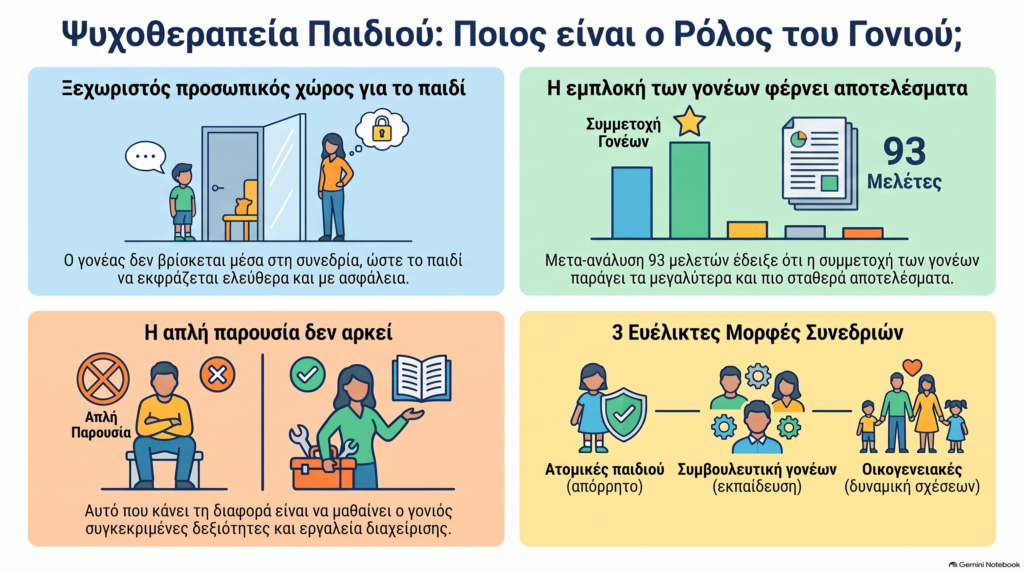
It doesn't mean you will sit inside your child's session. The child needs their own separate space, where they can speak freely, without feeling that they are watching over or protecting you. Your participation usually takes place through separate parent counselling sessions, alongside the child's individual psychotherapy. At the same time, but not inside the same room.
When does my participation as a parent help the most?;
Across a wide range of childhood difficulties, parental involvement significantly enhances the outcome of therapy.
An extensive meta-analysis of 93 studies showed that, among all the factors examined, parental participation was the one that produced the largest and most consistent results. The child does not live in a vacuum. He lives within a family, and the more the family understands what is happening to him, the more easily the change «sticks» outside the therapy room.
Are there cases where my mere presence does not change anything?;
Yes, and this is where the most interesting, less widespread finding lies.
In more specific cases, such as anxiety disorders, research shows something more complex: the mere presence of the parent in the process does not always, by itself, improve the outcome. This does not mean that your participation has no value. It means that what counts is not just «being there», but what exactly you do in that role.
What kind of participation actually helps?;
When you are also learning along the way how to manage your relationship with your child differently.
According to research, when parents learn specific things, such as how not to inadvertently reinforce a child's fear or how to gradually transfer control to the child themselves instead of solving everything for them, then their involvement makes a real difference. This is essentially the purpose of parent counselling: not to «monitor» your child's psychotherapy, but for you yourself to acquire specific tools that reinforce what is already happening there.

How do we think about this at Reconnect Therapy?;
With the same systemic perspective that guides all our work: the child within the context of their family, and not isolated from it.
In the team of psychotherapists at Reconnect Therapy, when a child's therapy begins, we assess together with you whether and in what form your involvement would help. There are three different formats of sessions, and each serves a different purpose:
The individual sessions for the child remain the core of therapy: their own space, without the presence of anyone else, where they can speak freely.
The parent counselling sessions take place separately, without the child present, and focus on you: what skills you can learn, how to better support what is already happening in therapy, and how to manage your own questions or concerns as a parent.
The family sessions, finally, bring the child into the same room together with one or both parents (or other family members, if necessary), not to «report» what was said in the individual sessions, but to actively work on the family dynamic itself, right in front of everyone. This format is usually recommended when the child's difficulty is closely linked to something happening in the relationships at home: e.g. a change in the family, a conflict affecting everyone, or a communication pattern that needs to change collectively, rather than just through the child.
It is not simply a matter of whether you «attend» a particular type of session. What truly matters is the nature of your involvement: learning specific skills, or to actively participate in a process that concerns the whole family, depending on what your specific situation really needs.
Whatever is said in the child's individual sessions remains strictly confidential to them, but you will be informed about general guidelines that concern you, so that you can actively support them with the right tools, rather than just being present.
In short
You do not sit inside your child's session. Your participation takes place through separate parent counselling sessions, alongside their therapy. In general, parental involvement significantly enhances the outcome, but in more specific cases what matters is not simple presence, but learning specific skills that support what is already happening in therapy.
Frequently asked questions
Will I sit in on my child's session?; Usually not. Your participation takes place through separate parent counselling sessions.
How often do parent sessions take place?; This varies depending on the family's needs and the stage of the child's therapy.
Will I find out what my child says in their own sessions?; Not in detail. The child's privacy is protected, but you will be kept informed about general guidelines that concern you and, of course, if something is important for you to know as a parent.
Do both parents need to participate?; Not necessarily. One parent/guardian can participate, depending on the family situation.
What happens if I disagree with the other parent on how to handle something?; This is a very common issue. That is why parent counselling exists, to find a common, consistent direction. We can have agreed from the outset on how to address this sensitive issue together.
If you are trying to find the best way to support your child, get in touch with the therapeutic team at ReConnect Therapy here
Read also:
I would love to read your message… I make sure to read all messages and reply to as many as I can.
The article is based on the science of psychology and the clinical experience of psychotherapists. It has a psychoeducational character and does not replace psychotherapy, medical or psychiatric evaluation, nor can it cover the uniqueness of every relationship and every lived experience. If you are experiencing intense mental distress, dysregulation, violence, coercion or the feeling that you are not a safe person within your relationship, it is important to seek personalised professional support.
Artificial intelligence may be used supportively in the process of researching, organising and cross-referencing contemporary literature. However, the final text, ideas, clinical judgement, language and responsibility for publication belong to us. Every article is written and edited with human thought, clinical experience and respect for the person reading it.
Written by: Filippos Gkekas, Psychologist Psychotherapist, creator of ReConnect Therapy alongside the scientific team of ReConnect Therapy.
References
Bratton, S. C., Ray, D., Rhine, T., & Jones, L. (2005). The efficacy of play therapy with children: A meta-analytic review of treatment outcomes. Professional Psychology: Research and Practice, 36(4), 376–390.
Manassis, K., Lee, T. C., Bennett, K., Zhao, X. Y., Mendlowitz, S., Duda, S., Saini, M., Wilansky, P., Baer, S., Barrett, P., Bodden, D., Cobham, V. E., Dadds, M. R., Flannery-Schroeder, E., Ginsburg, G., Heyne, D., Hudson, J. L., Kendall, P. C., Liber, J., Masia-Warner, C., Nauta, M. H., Rapee, R. M., Silverman, W., Siqueland, L., Spence, S. H., Utens, E., & Wood, J. J. (2014). Types of parental involvement in CBT with anxious youth: A preliminary meta-analysis. Journal of Consulting and Clinical Psychology, 82(6), 1163–1172.