

Parent-Teenager Conflict: When Is It a Normal Transition, When Does It Need Help
Reading time: 9 minutes
By the end of this article, you will understand:
- why tension with your teenage child is increasing, even if your relationship has always been good,
- why conflict does not necessarily mean something is going wrong between you,
- what is the developmental purpose of the distance that your child is taking,
- when conflict goes beyond the expected and deserves attention,
- what role psychotherapy can play at this stage and why the parent's role does not stop where the teenage child's therapy begins.
Your child, who has entered adolescence, has just slammed their bedroom door on you, after a conversation that started from something trivial, like a «tidy your room» and escalated into tension that no one expected. You sit outside their room for a moment and wonder when this child, who a few years ago used to tell you everything, changed. Perhaps the first thought that comes to your mind is: ’The relationship we had is broken«.
From our therapeutic experience, however, in the team of ReConnect Therapy, we can tell you that the truth is different and more hopeful than you imagine.
Why is conflict with your teenage child increasing, when previously your relationship was calmer?;
The increase in tension does not mean that the relationship is getting worse, but that it is changing form, as your adolescent child is developing the ability to disagree, negotiate and assert their own opinion.
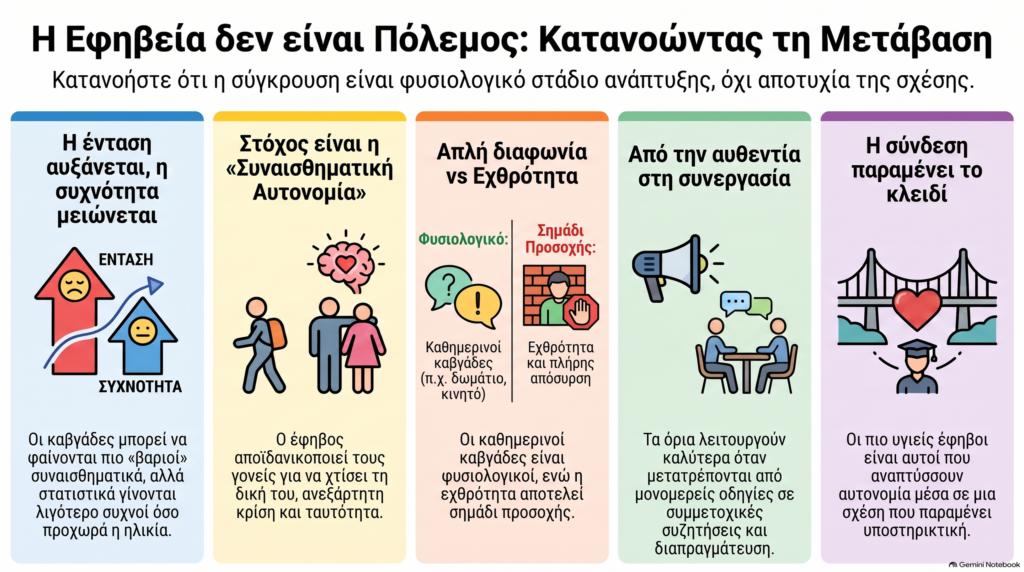
The largest meta-analysis ever conducted on the subject, involving dozens of studies, shows something different from what most parents believe: the frequency of conflict does not steadily increase throughout adolescence; on the contrary, it decreases with age. What increases at the beginning of adolescence is the emotional intensity of each episode. In other words, you may argue a bit less often than you think, but every time it feels much heavier. This explains why your experience can feel so intense, even though it actually involves fewer, more charged moments.
Let us imagine the following scenario: The mother of 14-year-old E. described how her daughter «she had become a different person». She would answer with single words, react strongly even to simple requests, and spend hours locked in her room. The mother's initial interpretation was personal: «She doesn't want me near her anymore». During the discussion, however, something different emerged: E. was not rejecting her mother. She was awkwardly and intensely trying to claim a space of her own, without yet having the tools to do so calmly.
(The above elements do not picture a single case, but constitute a synthesis of incidents, for the protection of privacy.)
“Mum I Love You, but I do not belong to you!” How much parenting is actually enough?;
Does tension mean that something is going wrong in our relationship?;
No, parent-teenager conflict is one of the most well-documented «normative» characteristics of adolescence, meaning it appears in almost all families, regardless of the previous quality of the relationship. A meta-analysis of 52 studies confirms that parent-adolescent conflict is a normal feature of this period, with the critical element not being the existence of disagreement, but its quality , meaning that simple disagreement (e.g. over curfew, bedroom, mobile phone) does not have the same effect as hostility (e.g. insults, contempt) in how it affects the teenager. Simply put: disagreeing is not the problem. How you disagree is what matters.
How to keep difficult conversations productive (4 ways)
What is the developmental purpose of the distance a child takes during adolescence?;
The distance taken by the adolescent child is not a rejection of the relationship, but the tool through which they build their own identity, independent of the image they had of their parents as a child. This process, known as «emotional autonomy», was first described in 1986 by Steinberg and Silverberg as developmentally necessary: the teenager needs to gradually de-idealise their parents, meaning to see them as human beings rather than infallible authorities in order to build their own independent judgement.
The most important finding, however, comes from subsequent research: the children with the healthiest adjustment in adolescence are not those who «cut off» the relationship with their parents, but those who developed autonomy inside in a relationship that remained supportive. In other words, the goal is not less of a relationship, but a relationship of a different type, where the adolescent child has more space without losing connection.

When does conflict go beyond what is expected and require professional support?;
Conflict deserves more attention when it takes the form of hostility rather than a simple disagreement, or when it is accompanied by complete withdrawal, a drop in school performance, or signs of intense psychological distress.
If the tension is limited to arguments over specific, everyday issues (curfews, cleanliness, screen time) and the adolescent child maintains relationships with friends, functions at school and shows, even occasionally, moments of connection with you, this falls within the expected spectrum of the transition.
If, on the other hand, you notice complete silence and withdrawal, or signs reminiscent of a more serious difficulty, as we discuss in more detail in our article Psychosis in young people: Why are diagnoses increasing?; then the picture goes beyond normal autonomy negotiation and requires more careful assessment.
What role can therapy play at this stage?;
In their team ReConnect Therapy we often see teenagers who do not need «fixing». What they are looking for is a space where identity exploration, tension with parents, or pressure from school and peers can be expressed without the fear of letting anyone down. Something that is often easier to do with someone outside the family dynamic.
This does not negate your role as a parent; it complements it, giving your teenage child a second, independent point of support as they go through this transition.
Do I need to come to therapy as well, or just my child?;
In most cases, some degree of parental involvement improves the outcome of your teenager's therapy, without this meaning that all therapy takes place with you.
A recent meta-analysis looking specifically at adolescent interventions found that interventions with some degree of parental involvement had significantly better outcomes than treatment of the adolescent alone, particularly for behavioural difficulties. In practice, this does not mean sitting in on every session. It means that, depending on the case, there may be separate meetings with you so that you understand what is happening and how you can support the process from the outside, while your child maintains their own private space within their therapy. This balance—respecting the child's autonomy during adolescence while keeping the parent informed and supported—is precisely the therapeutic approach we use at individual psychotherapy at ReConnect Therapy.
In short
Increased tension with your teenage child is not a sign that something has broken in your relationship. It is the expected outcome of a developmental process, where the adolescent is building their own identity, without this necessarily meaning less connection with you. Conflict warrants special attention when it takes the form of hostility or is accompanied by withdrawal and dysfunction, rather than when it is simply a disagreement.
If you decide to seek professional support, your role as a parent does not stop where the adolescent's therapy begins; on the contrary, it complements it.
Frequently asked questions
Is it normal for my teenage child to talk to me much less than before?; Yes, it is one of the most common signs of emotional autonomy. It doesn't necessarily mean a rupture, as long as some moments of connection remain, even if only occasional.
How do I talk to a teenager who reacts to everything I say?; It helps to reduce absolute instructions and leave room for negotiation on low-risk issues. The feeling of being heard often defuses tension better than insisting on «because I said so».
The role of friends is becoming more important than me. Should I be worried?; No, on its own it is not a worrying sign; on the contrary, the increased importance of peers is an expected part of adolescent development, not an indication that you are losing your place.
Should I have the same rules as before, or do I need to change something in the way I set boundaries?; Boundaries remain essential, but the way you set them benefits from shifting from one-sided instructions to more collaborative discussions where you explain your reasoning.
Is him/her not sharing anything personal with me a sign of distance or something normal?; This is often normal at the beginning of adolescence; it becomes a red flag only if it is accompanied by complete withdrawal from all relationships, not just from you.
When does conflict cease to be normal and require professional intervention?;
When everyday disagreements (e.g. over chores, screens) turn into systematic hostility, contempt or insults, as well as when they are accompanied by complete social withdrawal, a sudden drop in academic functioning or intense emotional distress.
Do I need to come too, or just my child?; Usually, some degree of parental involvement—not necessarily in every session—improves the outcome, while the adolescent maintains their own private space within therapy.
If your child has entered adolescence and certain signs are worrying you, get in touch with us here so we can tackle it together.
Read also:
- Happy children = happy parents! Or is it the other way around?;
- “I don’t want to be like my parents!”
I would love to read your message… I make sure to read all messages and reply to as many as I can.
This article is based on the science of psychology and the clinical experience of psychologists and psychotherapists. It has a psychoeducational character and does not replace psychotherapy, medical or psychiatric evaluation, nor can it cover the uniqueness of every relationship and every lived experience. If you are experiencing intense psychological strain, dysregulation, violence, coercion or the feeling that you are not a safe person within your relationship, it is important to seek personalised professional support.
Artificial intelligence may be used supportively in the process of researching, organising and cross-referencing contemporary literature. However, the final text, ideas, clinical judgement, language and responsibility for publication belong to us. Every article is written and edited with human thought, clinical experience and respect for the person reading it.
Written by: Philippos Gkekis, Psychologist Psychotherapist, creator of ReConnect Therapy together with the ReConnect Therapy scientific team
References
Lamborn, S. D., & Steinberg, L. (1993). Emotional autonomy redux: Revisiting Ryan and Lynch. Child Development, 64(2), 483–499.
Laursen, B., Coy, K. C., & Collins, W. A. (1998). Reconsidering changes in parent-child conflict across adolescence: A meta-analysis. Child Development, 69(3), 817–832.
Pine, A. E., Baumann, M. G., Modugno, G., & Compas, B. E. (2024). Parental involvement in adolescent psychological interventions: A meta-analysis. Clinical Child and Family Psychology Review.
Steinberg, L., & Silverberg, S. B. (1986). The vicissitudes of autonomy in early adolescence. Child Development, 57(4), 841–851.
Weymouth, B. B., Buehler, C., Zhou, N., & Henson, R. A. (2016). A meta-analysis of parent-adolescent conflict: Disagreement, hostility, and youth maladjustment. Journal of Family Theory & Review, 8(1), 95–112.