

Reading time: ~6 minutes
By the end of this article, you will understand:
- why observing «invisibly» an online community does not make you passive, but an active member of a broader digital ecosystem,
- how silent behaviour (lurking) acts as a systemic self-protection mechanism against digital fatigue and social anxiety,
- how quietly reading mental health communities offers a valuable sense of inclusion and pre-diagnostic recognition, without the risk of exposure.
You are reading a heated discussion on a digital forum, nodding along to a post that captures exactly how you feel, or scrolling through your friends' social media updates. All this time, your fingers remain poised over the keyboard. You think about writing something, leaving a comment, sharing your own thought, but hesitate. Eventually, you pull your hand back, close the app and remain in the background.
If this scenario sounds familiar, you are not a strange or socially isolated individual. Quite simply, you belong to the overwhelming yet invisible majority of the modern internet that participates silently.
The following example is a composite clinical portrayal based on common digital behavioural patterns. Names and details have been changed to protect privacy.
Alexis, 34, has spent the last few months spending hours reading specific communities (subreddits) on Reddit concerning neurodivergence, ADHD and autism in adults. Every time he reads a post about the difficulty of organising the day or the feeling of constant mental overload, he feels a knot in his stomach untie. «I am not defective, there are others like me», he thinks, nodding.
However, Alexis has never hit «publish». He has never given an upvote or written a single word. The mere idea of exposing himself, receiving criticism or having to defend his experience against strangers causes him physical tightness. He prefers to remain an invisible visitor, drawing safety from his silence.
What is online lurking and why it concerns the majority of people;
It is a practice where a user watches, reads or consumes content in online communities and social media without engaging in active participation, such as comments, likes or posts. Although historically the term initially had a slightly negative connotation, implying a «freeloader» who takes information without giving anything back, modern psychological and systemic analysis proves otherwise.
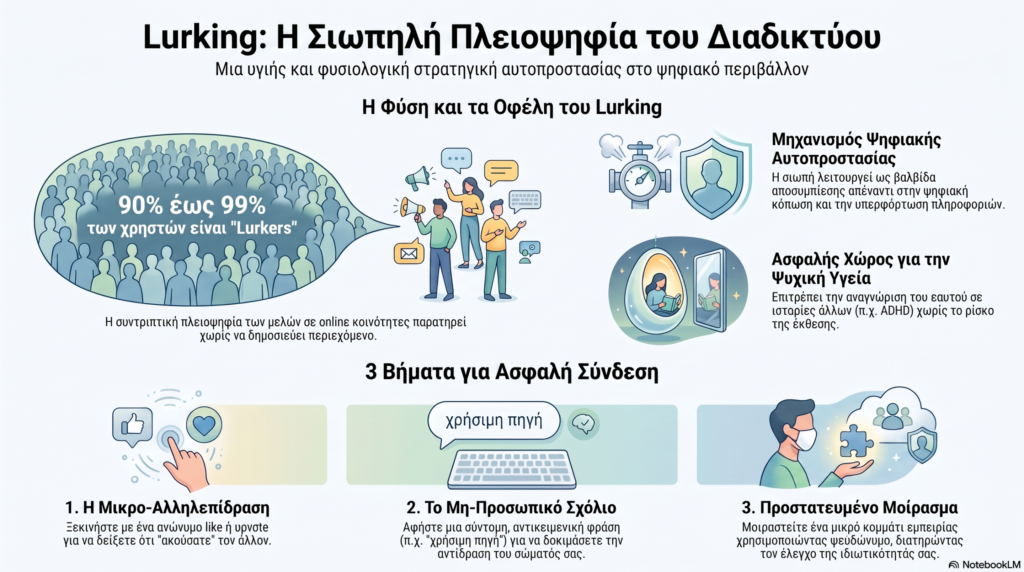
Silent participation is not passivity, but a valid, active form of learning, orientation and integration into the unwritten rules of a group. Since the birth of the first digital communities, research has shown that the so-called lurkers consistently make up 90% to 99% of members, with this variation being influenced by the type of community. For example, communities related to health topics tend to have higher rates of active participation compared to purely technological mailing lists.
From a systemic perspective, an online community consists not only of those who speak up, but also of those who listen. Silent observers maintain the balance, shaping the «background» of the digital system and allowing the community to maintain its homeostasis without collapsing from excessive informational noise.
Why do most users choose silent behaviour on social media?;
They choose it as a conscious self-protection strategy against digital fatigue, information overload and the need to safeguard their privacy. In the modern digital environment, the constant demand to have an opinion on everything, to interact and to manage multiple digital roles leads to a severe relational dead end.
Silence becomes a defence against the fatigue caused by the platform itself. When our nervous system is confronted with a barrage of data, withdrawal into invisibility acts as a decompression valve. The emergence of social anxiety and social media fatigue are the most significant factors predicting when an individual will choose to remain on «Left on Read», meaning to read without replying.
In our therapeutic team at ReConnect Therapy we often observe that the need to withdraw into silence is not a sign of indifference. It is a signal that personal self-care reserves have been depleted and the individual is trying to protect their vitality.
How does the need for social acceptance shape our online silence?;
The need for social acceptance shapes our online silence through the fear of public exposure, social anxiety and concern for protecting our public image in front of a potentially critical audience. On the internet, every post or comment constitutes an existential imprint which remains exposed to misinterpretation and criticism.
This mechanism is also deeply rooted in our cultural background. In societies or contexts where collectivism and the opinion of others play a decisive role, concern for «face», meaning the avoidance of public shame or social rejection, directly drives users towards silent observation. Not risking exposure is a mature, self-protective move. Interestingly, people with higher levels of trait mindfulness manage to mitigate this anxiety, as they can observe digital dynamics without internalising criticism.
Understanding these social structures helps us recognise and accept the value of our silence.

Why do we usually read about mental health without commenting?;
Quietly reading mental health posts is chosen because it allows users to experience a sense of inclusion and pre-diagnostic recognition in issues such as ADHD or autism, while avoiding the stigma or the vulnerability of personal disclosure. In recent years, digital platforms like Reddit have become arenas where references to neurodiversity converge and overlap significantly, highlighting shared challenges around adult diagnoses.
For someone trying to understand their own mental processing, lurking in such communities offers an invaluable service. It allows them to quietly map out their symptoms and to recognise himself in the stories of others, without the pressure of having to «prove» anything. It acts as an intermediate, safe station before making major decisions about his life.
In team psychotherapists of your ReConnect Therapy we believe that the quiet recognition of ourselves through the stories of others is the first valuable step in the process of self-awareness.
When does silent observation require professional support?;
Although lurking is a completely normal and healthy strategy, there are times when silence ceases to be a protective choice and turns into a compulsive restriction. It is worth seeking deeper support when:
- your online silence stems from a intense, paralysing fear that «if I speak, everything will be destroyed» or that «I am not an important enough person to be heard».
- you feel profound loneliness and fragmentation, even though you spend hours watching other people's stories.
- η physical your reaction (tachycardia, tightness), when you think about interacting, reveals that your nervous system is in a constant state of alarm.
3 steps to move from safe observation to authentic connection
If you feel you want to try transitioning from lurking to a more active form of presence, you can follow this practical guide at your own personal pace:
Step 1: Micro-Interaction
Start with an anonymous “like” or upvote on a post that resonated with you.
It is a way to say «I hear you» without exposing yourself.
Step 2: The Non-Personal Comment
Write a short, objective phrase (e.g. «Very useful resource, thank you»).
Notice how your body feels when you leave a quiet footprint.
Step 3: The Authentic, Protected Sharing
Share a small piece of your own experience using a pseudonym.
Remember: You don't need to reveal your whole story to connect.
Frequently Asked Questions
Is lurking a sign of social anxiety?;
Not necessarily. Although social anxiety can lead to silent behaviour, most people lurk for practical reasons, such as saving time, gathering information and protecting their privacy from digital overload.
Can lurking help my mental health?;
Yes, it can be very supportive. By reading about other people's experiences in safe environments, the feeling of loneliness and stigma is reduced, giving you a valuable sense of belonging, even if you remain silent.
What is the difference between healthy lurking and passive isolation?;
Healthy lurking fills you with knowledge, relief, and a sense of security. In contrast, passive isolation is accompanied by intense self-criticism, jealousy, guilt, and the feeling of being excluded from the «dance of relationship» and social life.
In short
Online lurking is not a pathology nor a sign of weakness, but the statistical and psychological norm of our digital reality. Silent participation acts as an essential mechanism for systemic balance and personal self-protection, allowing us to seek authentic recognition and knowledge at our own, safe paces.
However, if at any point you feel the need to talk about something that's on your mind, you can get in touch with us here
Read also:
“I have something important to say, but every time I get the chance I avoid it, what should I do?”
I would love to read your message… I make sure to read all messages and reply to as many as I can.
The article is based on the science of psychology and the clinical experience of psychotherapists. It has a psychoeducational character and does not replace psychotherapy, medical or psychiatric evaluation, nor can it cover the uniqueness of every relationship and every lived experience. If you are experiencing intense mental distress, dysregulation, violence, coercion or the feeling that you are not a safe person within your relationship, it is important to seek personalised professional support.
Artificial intelligence may be used supportively in the process of researching, organising and cross-referencing contemporary literature. However, the final text, ideas, clinical judgement, language and responsibility for publication belong to us. Every article is written and edited with human thought, clinical experience and respect for the person reading it.
Written by: Philippos Gkekis, Psychologist – Psychotherapist, creator of ReConnect Therapy alongside the ReConnect scientific team Therapy
References
Edelmann, N. (2013). Reviewing the definitions of “lurkers” and some implications for online research. Cyberpsychology, Behavior, and Social Networking, 16(9), 645–649.
Hong, Y., Hu, J., & Zhao, Y. (2023). Would you go invisible on social media? An empirical study on the antecedents of users’ lurking behaviour. Technological Forecasting and Social Change, 187, 122237.
Hu, B., Zhu, Y., Liu, C., Zheng, S., Zhao, Z., & Bao, R. (2024). Collectivism, face concern and Chinese-style lurking among university students: The moderating role of trait mindfulness. Frontiers in Psychology, 15, 1298357.
Kang, J., Haslam, N., & Conway, M. (2025). Converging representations of attention-deficit/hyperactivity disorder and autism on social media: Linguistic and topic analysis of trends in Reddit data. Journal of Medical Internet Research, 27, e70914.
Liu, X., Feng, R., Chen, X., & Yuan, Y. (2024). “Left on read” examining social media users’ lurking behaviour: An integration of anxiety and social media fatigue. Frontiers in Psychology, 15, 1406895.
Nonnecke, B., & Preece, J. (2000). Lurker demographics: Counting the silent. In Proceedings of the SIGCHI Conference on Human Factors in Computing Systems (pp. 73–80). ACM.