

Reading time: ~10 minutes
By the end of this article, you will understand:
- which is truly more effective, individual or group psychotherapy,
- why they work in completely different ways, even though they arrive at similar outcomes,
- when suits you each one better,
- and how a therapeutic journey combining both is usually structured in practice.
Almost everyone thinking about starting therapy goes through the same dilemma: «Should I do individual therapy with a therapist, or join a group?» The underlying assumption is that one must be «better» than the other. Research and our own clinical experience suggest something more interesting: that often, the question is not «either/or» but «when which».
Which is more effective, individual or group psychotherapy?;
Neither is generally «better» than the other. Research shows equivalent results in most cases.
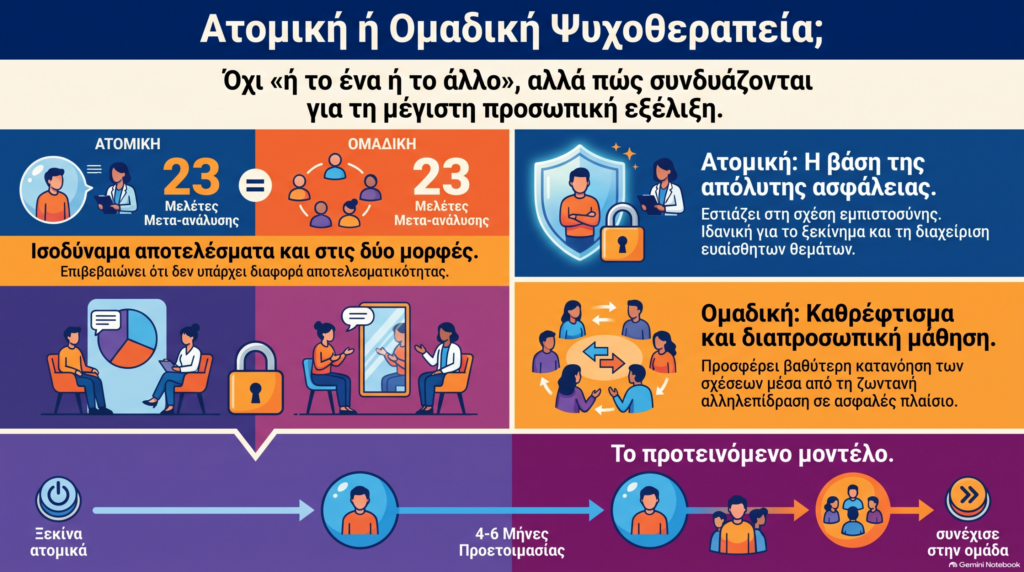
A meta-analysis of 23 studies directly comparing the two formats within the same research reached a clear conclusion: there is no consistent difference in effectiveness between individual and group therapy. This conclusion remained consistent, regardless of who the client was, who the therapist was, or which method was being examined.
If they are equally effective, why does each work differently?;
Because they activate different mechanisms of change, meaning they have the same destination, but a different route.
In individual psychotherapy, the primary lever for change is your relationship with the therapist. The stronger this relationship is, the better and more consistent the outcome. In Reconnect Therapy, individual sessions last 50 minutes, with a usual frequency of once a week. This can be increased to 2-3 times during periods of crisis, or decreased, but it never drops below 2 times a month, as this significantly reduces the effectiveness of the process.
In group psychotherapy, the main driver is different.: group cohesion and interpersonal learning that takes place live, through interaction with the other members, something we describe in more detail in the article «You are not alone». Group sessions last longer, approximately two hours, once a week, precisely because more time is needed for each member to be heard and for dialogue to develop between them.

When is individual therapy best suited for you?;
When you first need a highly personal, completely safe space, before sharing anything with others.
Let us imagine a complex case that does not correspond to a real person.
An individual arrives in therapy carrying something deeply personal, such as a secret they carry within themselves like shame and have never told anyone. The thought of sharing it in front of a whole group of people, even a safe one, paralyses them. In individual therapy, by contrast, they build trust at their own pace with just one person.
That is why, in our model, the therapeutic journey usually begins with individual psychotherapy. To first build a secure, stable relationship of trust, before any other form of therapeutic approach is considered.
When is group therapy best suited for you?;
When your issue is fundamentally relational and you have already built a foundation of safety through individual work.
In our therapeutic model, joining a group is usually recommended after 4-6 months of individual psychotherapy. Not as an arbitrary rule, but because sufficient safety has usually been built there already for you to truly make the most of what the group uniquely offers you: the deepening of your therapeutic process and the exploration of your relationship dynamics, live, in front of and together with other people. This decision is not made unilaterally. It is a joint decision, yours and the therapist's, made based on whether it truly suits your current stage.
Something else worth knowing before you start group psychotherapy: it does not always bring immediate relief, especially if effective individual therapy has preceded it. And this is completely normal, not a sign that something is not working. A commitment is recommended, for at least the first 12 sessions, so that you can get a truly clear sense of how much it benefits you.
Can I do both together?;
Yes, and in practice, this is the most common path, not the exception.
At therapeutic approach ours, we do not view individual and group therapy as two competing choices, but rather as sequential or parallel stages of the same journey: first, individual therapy builds the foundation, and then group therapy deepens the work at the relational level. After all, this is the same systemic perspective that guides all our work: we do not see you as an isolated «case», but as a person within a context, with a therapeutic path that evolves according to where you are.
In short
Research does not show a generally «better» choice between individual and group therapy, but rather equivalent outcomes, through entirely different mechanisms. The therapeutic journey usually begins with individual psychotherapy, and after 4-6 months, provided it suits you, it can be enriched with group therapy for deeper work on your relational dynamics.
Frequently asked questions
Do I need experience in individual therapy before joining a group?; In our model, yes, usually. The journey starts with individual therapy and moves on to group therapy after 4-6 months, if and when it suits you.
Is group therapy cheaper than individual?; Group therapy operates on a monthly subscription, which has a different cost structure than individual therapy. However, this should not be your sole deciding factor.
Does the therapist decide if I am suitable for a group?; It is a joint decision, made by both you and your therapist, based on whether it truly fits your needs.
Can I switch from one format to the other along the way?; Yes, in fact, that is the most common path in our model.
Which is better for specific, «heavy» issues (e.g. trauma)?; Individual psychotherapy initially offers the safe space that a highly sensitive issue needs, with group therapy coming later, if and when it suits your therapeutic journey.
How do I start?;
You don't need to decide on your own which is best, or when is the right time for a group. All you need to do is tell us what brings you here. We'll figure out the rest together, step by step.
Read also:
- The most important “qualification” of a therapist. How to choose correctly in individual therapy.
- Group psychotherapy
- It's not just your fault. Why in systemic psychotherapy the “I” is explained through the “we”
I would love to read your message… I make sure to read all messages and reply to as many as I can.
The article is based on the science of psychology and the clinical experience of psychotherapists. It has a psychoeducational character and does not replace psychotherapy, medical or psychiatric evaluation, nor can it cover the uniqueness of every relationship and every lived experience. If you are experiencing intense mental distress, dysregulation, violence, coercion or the feeling that you are not a safe person within your relationship, it is important to seek personalised professional support.
Artificial intelligence may be used supportively in the process of researching, organising and cross-referencing contemporary literature. However, the final text, ideas, clinical judgement, language and responsibility for publication belong to us. Every article is written and edited with human thought, clinical experience and respect for the person reading it.
Written by: Filippos Gkekas, Psychologist Psychotherapist, creator of ReConnect Therapy alongside the scientific team of ReConnect Therapy.
References
Flückiger, C., Del Re, A. C., Wampold, B. E., & Horvath, A. O. (2018). The alliance in adult psychotherapy: A meta-analysis. Psychotherapy, 55(4), 316–340.
McRoberts, C., Burlingame, G. M., & Hoag, M. J. (1998). Comparative efficacy of individual and group psychotherapy: A meta-analytic perspective. Group Dynamics: Theory, Research, and Practice, 2(2), 101–117.
Yalom, I. D., & Leszcz, M. (2005). The theory and practice of group psychotherapy (5th ed.). Basic Books.