

Book review: The Burnout Society
Reading time: 5 minutes
By the end of the article, you will have:
- a clear picture of the way in which the book The Burnout Society by Byung-Chul Han has so deeply influenced the discussion surrounding workplace stress and everyday self-oppression,
- a balanced look at both the strengths of his philosophy and those areas that require attention,
- an initial introduction to the recent discourse surrounding over-optimisation (over-optimization), the internalised compulsion and the reclaiming of our authentic vitality.
Why I chose this book
The The Burnout Society is undoubtedly one of the books that radically changed the way we interpret modern burnout. It provided an explanation for why people who theoretically have the freedom to define their lives end up feeling permanently exhausted, fragmented and a trapped.
It essentially succeeded in deconstructing the pre-existing illusion that pressure always comes from the outside. The psychological pain of modern man therefore appears to not stem from an external oppressor, but from an internal cognitive schema that demands constant optimisation. This experience of the «I can» or «I can do better» quickly translates into a permanent emotional strain, like a a Ferrari without brakes running non-stop to catch up with a nonexistent goal.
Ως ψυχολόγος-ψυχοθεραπευτής, συναντώ συχνά ανθρώπους, ιδιαίτερα high performers, που έρχονται για θεραπεία, επειδή έχουν εσωτερικεύσει έναν ρόλο που δεν τους επιτρέπει ποτέ να ξεκουραστούν.
Αυτό που ξεχωρίζει στο The Burnout Society είναι ότι μας βοηθά να περάσουμε από το «είμαι ανεπαρκής, επειδή κουράστηκα» στο «κουράστηκα, επειδή προσπαθώ να ικανοποιήσω μια αόρατη καθηκοντολαγνεία». Την ίδια στιγμή, επειδή η ανάλυση του Χαν είναι έντονα θεωρητική και φιλοσοφική, χρειάζεται ένα κριτικό βλέμμα για να συνδέσουμε τις έννοιες με την πραγματική θεραπευτική διεργασία.
The Core Idea of The Burnout Society
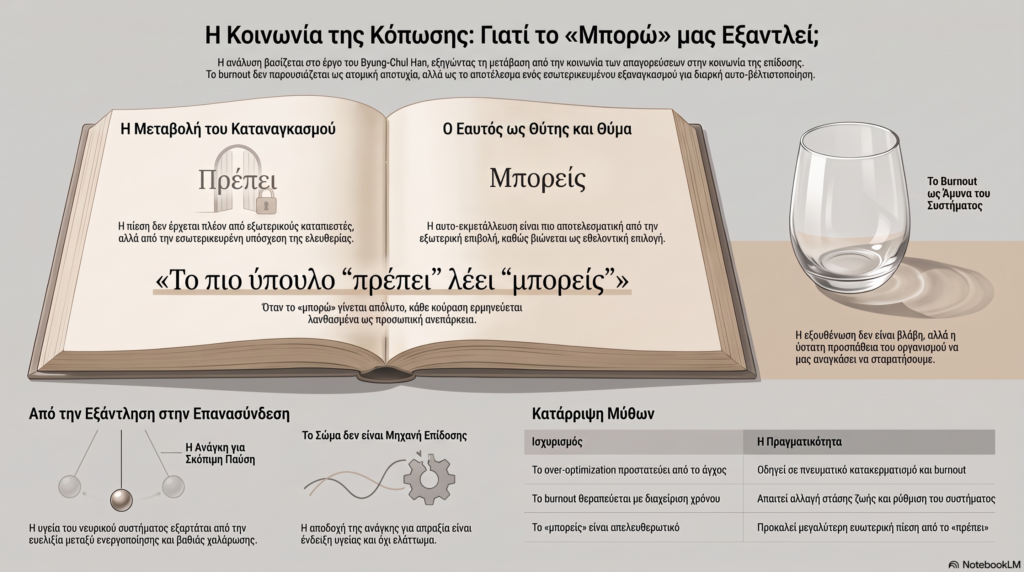
What the book mainly describes is that we have moved from the «st1"disciplinary society» (which was based on prohibitions, restrictions and «must») to the «st2"performance society» (which is based on motivation, projects and «you can»).
Therefore, burnout is not an individual weakness, but the inevitable psychosomatic experience of a society that turned freedom of choice into an unstoppable internalized performance compulsion.
As a primary lens, this transformation explains why the depression and fatigue in our day and age are not symptoms of disobedience, but the result of a voluntary, total exploitation of ourselves by our very own selves.
Which phrase captures the Central Idea
«The most insidious “must” does not say “you must”, but “you can"“.»
This has immense therapeutic value, because along the journey of reconnecting with ourselves, others and the world, we often see that the biggest trap is our inner voice which turns every desire into an obligation. When «I can» becomes absolute, the individual simultaneously transforms into both the perpetrator and the victim of themselves. The goal of therapy is not to become more productive, but to allow our parts to communicate with one another, making space for authentic pleasure and intentional pause.
Who it is for
It primarily offers answers to people who are constantly trapped in cycles of burnout, perfectionism and self-criticism. It can also serve as a useful guide for anyone involved in mental health who wants to understand the existential footprint that modern over-optimization culture leaves on clients.
What the research shows
Modern clinical and organisational research clearly supports the link between workaholism, perfectionism and the emergence of clinical symptoms of anxiety and depression. The continuous need for self-optimisation systematically depletes mental reserves, confirming that internalized pressure is just as destructive as external stressors.
In more detail:
| Claim | What we need to take away |
| «You can» creates more pressure than «you must». | Yes. When pressure is internalized, failure is experienced as a personal inadequacy, reinforcing self-criticism. |
| Over-optimization protects against anxiety. | No. Science shows that an excessive focus on productivity leads to mental fragmentation and burnout. |
| Burnout is cured with better time management. | False. Burnout is a profound crisis of meaning and system regulation, which requires a change in life attitude, not simply new routines. |
A newer theoretical perspective: The body turned into a performance machine, opposing the rhythm of the nervous system
A more recent psychological discussion takes Han's analysis one step further. In team of our psychotherapists in ReConnect Therapy we often observe that our tendency towards over-optimization treats the body like a machine that must perform incessantly, ignoring bodily signals of fatigue.
The nervous system is not a productivity warehouse, but a living system that needs rhythm. Modern neuroscience introduces the concept of metastatibility: the organism's capacity not to remain stuck in a single state, such as continuous hyperarousal and action, but to be able to move flexibly between activation and deep relaxation.
A healthy nervous system is not a system that constantly produces output. It is a flexible system. In the modern relational impasse of performance, this capacity for flexibility is lost. The system gets stuck on «on», the bottle empties and the body is led to inevitable collapse (burnout) as the only alternative defence against relentless pressure. Therefore, exhaustion is not a system failure, but its ultimate attempt to force us to stop.
Where our attention is needed
Where I would express a clearer reservation is regarding the intensely pessimistic and theoretical tone of the book. Han views this situation as a universal social fate, leaving very little room for individual resilience and therapeutic change. This can create a sense of absolute entrapment, making us feel as though we are helpless pawns of a society that forces us to burn ourselves out.
In reality, the therapeutic experience teaches us something more humble and hopeful. We humans are not simply victims of structures. Through the therapeutic relationship, self-awareness and the assertion of our personal boundaries, we can deconstruct these internalised roles. Change is an achievable process, provided we give ourselves the time and space to breathe outside the pursuit of performance.
How it deserves to be read
The The Burnout Society it deserves to be read as an important book for understanding our modern culture.
- Not as a self-diagnosis book that will load you with extra guilt.
- Not as yet another manual on the quality of your productivity.
- Not as a fatalistic realization that there is no individual way out.
Because it is a short book, I find it useful to read it all through first, so as to get an overall idea and then, on a second reading, to proceed slowly, deeply investigating the concepts you encounter and raising questions.
Open an internal dialogue about how the book relates to your own needs, what demands do you place on yourself, how do you perceive your worth, how much fatigue you feel daily. But be careful. If this dialogue causes you intense emotional strain, then continue it with caution and within a safe therapeutic framework.
The most useful attitude is to retain the book's philosophical perspicacity, but not to let any theoretical impasse rob us of the hope for personal transformation.
What to take away today
The most important thing this book can leave you with is the realization that your need to stop, not to act, to «do nothing», is not a flaw, but a sign of health.
When you see your exhaustion not as a personal failure, but as a healthy message from your organism asking for protection against over-optimization, then space will open up for self-compassion and the recognition that:
You are not a machine obliged to perform incessantly.
You are a living system with the right to pause, to calm, and to authentic completeness.
And this living system, by learning to set limits on the «I can», can rediscover its true vitality and move freely.
If you felt that The Burnout Society speaks to you, we can talk more here
Read also:
Burnout and holidays. And we don't mean sunburn.
Review of Four Thousand Weeks: Time Management for Mortals (Oliver Burkeman)
I will be very glad to read your message. I make sure to read all messages and reply to as many as I can.
The article is based on the science of psychology and the clinical experience of psychotherapists. It has a psychoeducational character and does not replace psychotherapy, medical diagnosis or personalised clinical assessment. If what you are reading touches upon intense psychological distress or significantly affects your daily functioning, it is important to seek personalised professional support.
Artificial intelligence may be utilised in a supportive capacity for literature research, organisation, deeper exploration and the verification of scientific data. Final responsibility, ideas, clinical judgement, format and final drafting belong to Filippos Gkekis and the scientific team, and are based on clinical experience and human processing.
Written by: Filippos Gkekis, Psychologist – Psychotherapist, creator of Reconnect Therapy, alongside the Reconnect Therapy scientific team.
References and Articles
- Han, B.-C. (2015). The Burnout Society. Stanford University Press.
- Melchior, M., Caspi, A., Milne, B. J., Danese, A., Poulton, R., & Moffitt, T. E. (2007). Work stress precipitates depression and anxiety in young, working women and men. Psychological Medicine, 37(8), 1119-1129.
- Schaufeli, W. B., Taris, T. W., & Van Rhenen, W. (2008). Workaholism, burnout, and work engagement: Three of a kind or three different kinds of employee well-being? Applied Psychology, 57(2), 173-203.