

(A complete guide to managing anxiety and other stressful emotions.)
What is anxiety? What is stress? (the psychological definition)
What is stress?;
Stress can be defined as any change in the external or internal (bodily) environment, which can cause emotional or psychological pressure. Stress is the body's response to anything that demands its attention, so that it can take action.
According to Sapolsky (1994), stress encompasses the concept of loss, specifically the loss of control, predictability, outlets, social support, and all these lead to frustration and an increasingly worsening perception of things.
It is interesting how the term stress derives from the root of the Latin strictus, which means tight or narrow and is the past participle of the verb stringere which means to squeeze. It literally describes how pressure increases on a solid body and is thus used to describe emotional or mental pressure.
What is anxiety?;
In our attempt to define anxiety, we could say that it is the subjective emotional feeling that every person has towards the stressful stimuli of life. The intensity of anxiety is related to a person's perception of a specific event, regarding whether they are in danger and to what extent, as well as whether they will be able to cope with it effectively (“will I manage it?”).
What is the difference between anxiety and stress?;
We hear both ourselves, and others daily using phrases during emotionally demanding moments such as: “I feel stressed”, “I am stressed out”, “I got anxious”, “I've been feeling a lot of anxiety lately” etc. The terms “anxiety” and “stress”, although frequently used to describe a perhaps common emotional state, are not identical and have the following differences. It is important to distinguish between the differences of anxiety and stress, because this distinction is of great importance beyond simply understanding them, influencing how we manage each one.
Firstly, stress refers to an internal state, which is characterised by the disruption of homeostasis in the here and now and originates from an environmental stimulus. For example, when we hit (stress) a piece of metal with a hammer. In our case, the blow constitutes the stressor, which causes an imbalance in the metal's molecules. Regarding humans, stress stimuli vary, such as the early morning rays of the sun, the digestion of food, exercise which at appropriate levels is beneficial for the organism and helps it grow and adapt to its environment in the best possible way. On the other hand, there are stressors such as a break-up, the death of a loved one, a change in daily life such as retirement, which might function negatively for the organism, because it will need more time to find its homeostasis again. The purpose of the body's stress response is to help us adapt as effectively as possible in the face of life's uncertainty and whatever challenges it offers us daily.
Moving on to anxiety, we can say that it constitutes a pervasive worry, which does not concern specific reasons as I described earlier for stress. The purpose of anxiety is to prepare us emotionally and mentally for events that, according to our experiences, our unconscious judges that it needs to prepare us for. Unlike stress (where the reasons are clear), in the case of anxiety there is not always full awareness of what is creating it.
Furthermore, we experience stress for as long as the stressor lasts, whereas with anxiety, even though the stressor has been removed, we continue to experience it.
If we take the example of retirement, during which objectively there are changes in daily life that need to be sorted out (change of lifestyle, habits, change of context both in work and interpersonal relationships etc.), these constitute a set of stressful situations. However, anxiety can be created by a crisis in a person's identity, feeling anxious about how they can exist in their new situation today and what meaning their life will have anymore.
This separation helps us tremendously in understanding, but also in stress and anxiety management. Specifically, regarding stress, our approach can focus on techniques for managing external situations (communication with people, time and energy management, organisation, goal setting, etc.). Whereas in the case of anxiety, it is important for information to come from our unconscious so that we can become aware of the deeper reasons why we experience anxiety and then aim to heal our corresponding internal parts.
Are anxiety and stress related?;
Yes, of course they are! One can cause the other. Specifically, when an external stimulus (such as a transfer at work) acts as stress on our organism, due to the changes that need to take place, it can simultaneously raise internal worries and anxiety, such as performance anxiety in the new position. Of course, the reverse can also happen; as we saw above, stress starts from a stressful stimulus, which could be internal and stem from anxiety. Continuing the example of the transfer, performance anxiety which is repeated with an internal dialogue such as: “I don't think I'll make it”, “I'm not capable”, “perhaps I'm not the right person for this position”, can be the stimulus for a stress reaction of the organism.
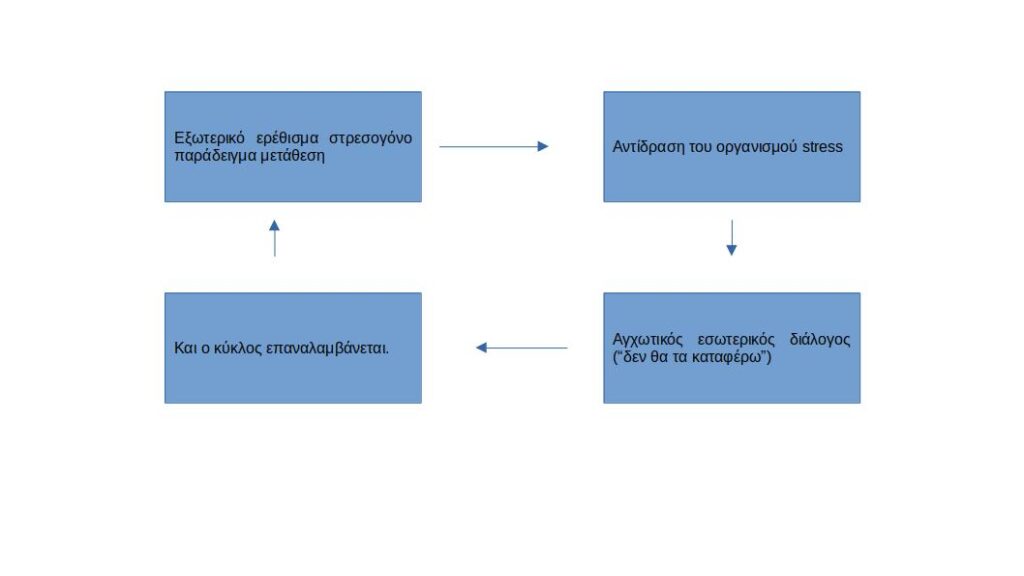
In this case, we can be led into a distressing vicious circle, where an external stimulus causes stress, stress mobilises the anxious internal dialogue, which acts as a stimulus for stress. The vicious circle I am describing is presented in the diagram below:
What are the symptoms of anxiety?;
Below I will describe simply and comprehensibly, away from incomprehensible psychiatric terms, what the symptoms of anxiety are or, in other words, how the psychologically stressful triggers of our daily lives show that our organism needs rest, peace, or even psychotherapy.
Very often, when the stressful stimuli we have to process are numerous and intense, we may come into contact with our emotions and express that all of this has affected us emotionally. Under the influence of intense stress you may feel:
- Irritability, lacking patience and getting annoyed at the slightest thing
- Intense anxiety, worry and fear
- Burnout, fatigue that is not resolved by everyday sleep
- A feeling that your thoughts are racing and you cannot stop them
- It is also likely that you will feel a sense of profound sadness when the situation does not seem to improve
- You notice a difficulty in finding satisfaction in your daily life and you easily lose interest in things
- You may feel that you are losing your sense of humour
- You notice past worries and emotional dead ends worsening
- Reduction in libido
Beyond feelings and emotions, due to the fact that stress greatly affects the hormonal system, we also observe physical symptoms such as:
- Difficulty sleeping
- Panic attacks
- Difficulty breathing, a feeling that the air is not enough
- Physical fatigue
- Tired eyes with the appearance of “dark circles”
- Stiff and painful muscles, especially in the neck and shoulders area, which often lead to headaches
- A feeling of increased pressure, sometimes accompanied by a mild nosebleed
- Chest pains
- Sudden weight loss or gain
- Development of skin conditions, such as acne and general skin irritation
- Sweating
- Impact on the menstrual cycle
- Worsening of pre-existing health issues and a general susceptibility to seasonal illnesses, infections, and typically a longer recovery time
- Hair loss
All of the above—meaning the sensations, symptoms, and expression of hormonal imbalance in the body—often lead us to behave in the following ways:
- Difficulty concentrating
- Nail-biting and other repetitive, stereotyped movements
- Indecisiveness
- Memory difficulties
- Teeth grinding, especially during sleep, resulting in dental wear and muscle pain in the temporomandibular joints upon waking
- Changes in diet, such as frequency, meal portions, etc.
- Increased need to use tobacco, drugs, or alcohol
- Frequent crying spells that occur without any obvious trigger
- Increase in emotional shopping
- Stopping a physical exercise routine or exercising with very high frequency and intensity
- Withdrawal from loved ones
When does stress become chronic? What are the effects?;
Stress becomes chronic when there are repeated stressors, whether different or similar. For us to say that the body is entering a state of chronic stress, , these stressors must occur with such frequency that the body cannot process them effectively, leading to eventual accumulation. If a stressor repeats before the body has finished processing the previous one, the subsequent stressor adds to it, producing an even greater hormonal response and resulting in bodily exhaustion.
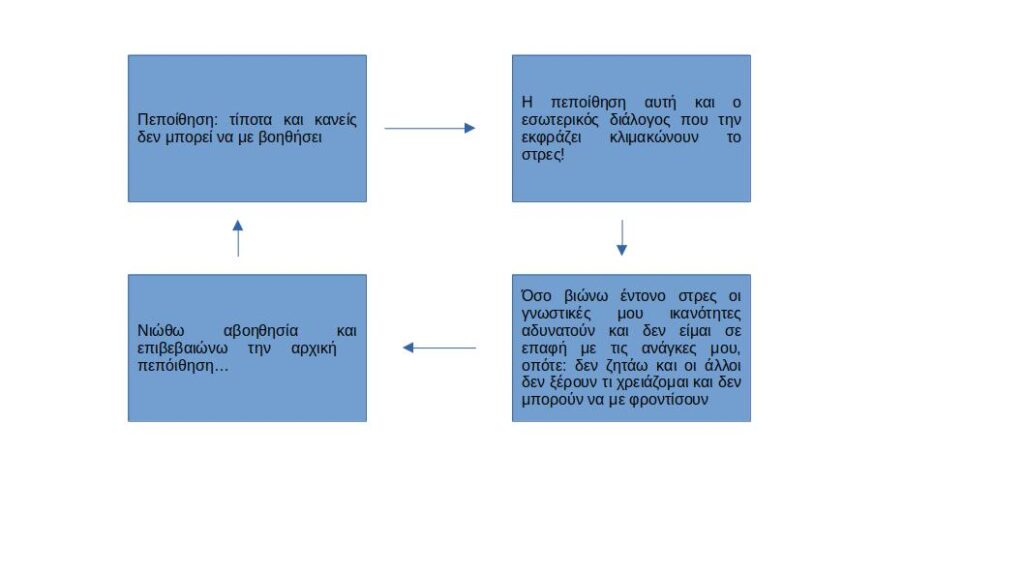
For example, when a person has experienced a significant loss a few months ago and has not had the chance to process the grief and all the emotions that come with it, then loses their job, and shortly after a health problem also appears, then having had no time for their system to process so many stressors, the tendency is to experience deep disappointment. As I also show in the diagram below, when stressors accumulate—meaning that through a human support framework there is no time and emotional space to process them—then stress and anxiety feed into each other, resulting in the person feeling that no matter what they do or how hard they try, there is no result, thus losing hope and feeling a deep sense of disappointment. This repeatedly fuels the belief that nothing can improve what causes them anxiety, and this anxiety becomes yet another stressor, and the cycle repeats. When this cycle repeats over and over and escalates, then in extreme cases the person is led into deep depression.
Human beings, as a species, over millions of years of evolution, have had to deal with a wide variety of stressors, and the more they were able to process them and regain their lost homeostasis, the more they evolved. In the modern era we live in, we may not be as troubled by rapid weather phenomena, our safety from the wild, where to stay to be safe and secure our food supply, but a multitude of stressors will continue to exist.
Examples could include chronic unemployment, relational deadlocks, the loss of loved ones, poverty, wars, outrageously high work demands, being the sole caregiver of a family member suffering from a chronic condition, and so many others. The explosion of information in itself constitutes a stressor; never before has the human brain had to manage so many and such complex stimuli in its daily life.
Unfortunately, chronic anxiety is implicated in the disruption of hormone secretion, which results in dysfunctions of individual cells as well as our entire organism (Chrousos 2015). Specifically, it is implicated in developmental deviations during childhood, obesity, sleep apnoea, hypertension, cardiovascular diseases, arteriosclerosis, diabetes, chronic fatigue, premature ageing of the organism, psychosomatic problems, carcinogenesis, depression, and more.
Unfortunately, the very harmful effects of stress are multiplied when the many biochemical changes brought about by stressors are amplified by behaviours that alter biochemistry. For example, a temporarily comforting coping strategy for stress is consuming large quantities of food, or typically foods with an unhealthy profile that produce a palatable, pleasurable effect. However, such dietary habits are associated with the secretion of more cortisol and insulin while simultaneously suppressing certain anabolic hormones. When this temporary stress-management strategy is repeated in terms of effectiveness, the person accumulates visceral fat, which leads to systemic inflammation and oxidative stress from which it is difficult to recover (Epel, 2009).
When is the contribution of a mental health specialist necessary for managing stress and anxiety? (Psychologist, psychiatrist, psychotherapist)
I must emphasise that in the modern era we live in, with information flowing uncontrollably, we must be very careful, especially when this information relates to our health, whether on a physical or emotional level. It is with great regret that I confirm daily how a multitude of professionals present themselves as mental health specialists without having been shaped through time-consuming and demanding educational processes.
I agree with the phrase that a half-truth is more dangerous than ignorance. This guide aims to inform you in a simple way so that when you need to make a decision about your mental health, you have the necessary information to make a very careful decision.
It is highly likely that as you are reading this guide and looking at the sensations and symptoms of stress, you are experiencing or have experienced a great many of them. This does not necessarily mean that you need the help of a professional. When we do not have the big picture, it is very easy to make connections that are false. I remember myself too, when I was studying psychopathology, very often questioning myself about many diagnoses, since the diagnostic criteria are so subjective that they could fit many aspects of my character. It has also been observed that medical students in the early years of their studies feel that whatever disease they are studying, they have its symptoms too, whilst being healthy!
I invite you to focus on whether all these things you are reading in this guide are seriously affecting your functioning. Specifically, I consider it effective in helping you understand whether you need the help of a professional, to ask yourself the following questions:
- Can I manage to take care of myself? (Satisfactory sleep, satisfactory rest, adequate nutrition, time for myself, personal hygiene);
- Do I derive satisfaction and feel a connection with the people close to me?;
- Am I functional in my work?;
- Do those around me see me as well, as they know me without noticing any changes in my behaviour or my mood?;
- Can I emotionally manage an event that has strongly affected me (breakup, loss, abuse)?;
If your answers to the above five questions are yes, then you probably do not need the help of a mental health professional. However, if you have answered no to some of the above questions and notice that your negative answer does not change as time goes on, then it is important to speak with a mental health professional.
Is there such a thing as good stress or good anxiety?;
Of course there is good stress! It is what woke you up this morning, when your biological clock triggered the secretion of cortisol! It is what motivates you to study, to flirt, to live and to discover things in your life! It is what improves and develops your cognitive abilities such as memory, decision-making and problem-solving skills. For scientists to study it and distinguish it from bad stress, they named it eustress, or otherwise beneficial stress. Beneficial stress is also what, whether we like it or not, keeps us alert when crossing a traffic light. It is essential for us to be functional, creative and to live our lives safely.
However, this same stress can also become bad, non-functional and harmful to our mental and physical health. The difference lies in its duration and intensity. Just as salt can flavour our food in the ideal amount, at the same time in a much larger amount it can ruin the taste completely.
As I also write in the paragraph on chronic stress, the sum of stress-inducing stimuli that the body is unable to manage leads to harmful, bad stress.
With the concept of good stress, there is no corresponding concept of good anxiety. Anxiety, as I wrote above, constitutes the subjective emotional feeling about life events. Its purpose is to warn us of impending danger in the future, but if it persists and makes us dysfunctional, it is like having an over-sensitively adjusted alarm. It does not make sense for our home alarm to go off at night just because a cat walked across the balcony.
How can I recognise my stress? (Free self-assessment test)
Below is a questionnaire (Perceived Stress Scale) which can act as a gauge of the intensity of the subjective stress you are experiencing. It is a scale that has been used for about 40 years and has also been standardised in Greek (Karadimas H., 2007, Katsarou A. 2012).
Please note! The purpose of providing the questionnaire below is simply for you to get an idea of where the intensity of the stress you are experiencing stands. This questionnaire in no way replaces an evaluation or diagnosis by a psychiatrist or psychologist.
Instructions
The test questions relate to your thoughts and feelings over the last month.
- Answer all questions
- Treat each question as separate, even if some may seem similar.
- For best effectiveness, try to answer quickly.
- For each question you have the following four alternative answers:
Never 0
Almost never 1
Sometimes 2
Fairly often 3
Very often 4
Note down the numbers that correspond to each answer you have given.
How do I score my test?;
Step 1
Reverse the numbers for questions 4, 5, 7 and 8. Where your answer is 0, note down 4. Where it is 1, note down 3 and so on (specifically 0=4, 1=3, 2=2, 3=1, 4=0).
Step 2
Add up all the numbers.
Step 3
Your score can range from zero to 40 and falls into the three groups below.
- If your score ranges from 0 to 13, you are considered to be experiencing low stress
- If your score ranges from 14 to 26, you are considered to be experiencing moderate stress
- And finally, if your score ranges from 27 to 40, you are considered to be experiencing high stress.
The questions:
- In the last month, how often have you been upset because of something that happened unexpectedly?;
- In the last month, how often have you felt that you were unable to control important things in your life?;
- In the last month, how often have you felt nervous and stressed?;
- In the last month, how often have you felt confident about your ability to handle your personal problems?;
- In the last month, how often have you felt that things were going your way?;
- In the last month, how often have you found that you could not cope with all the things you had to do?;
- In the last month, how often have you managed to control irritating things in your life?;
- In the last month, how often have you felt that you were on top of things?;
- In the last month, how often have you been angered about things that happened that were outside of your control?;
- In the last month, how often have you felt that difficulties were piling up so high that you could not overcome them?;
Here we note that this scale measures how you experience and to what extent you perceive the intensity of stress. This subjectivity in the perception of stress can lead two people to completely different results, even while the same things are happening in their lives. Here we can wonder how important the filter is through which we experience life's situations.
Sources:
Karadimas, H. (2007). Subjective stress and life satisfaction as mediating variables in the relationship between generalized expectations and health. Psychology 14 (1) 1-13.
Cohen, S., Kamarck, T., & Mermelstein, R. (1983). A global measure of perceived stress. Journal of health and social behavior, 385-396.
Cohen, S., Mermelstein, R., Kamarck, T., & Hoberman, H. M. (1985). Measuring the functional components of social support. In Social support: Theory, research and applications (pp. 73-94). Springer, Dordrecht.
Cohen, S., Kamarck, T., & Mermelstein, R. (1994). Perceived stress scale. Measuring stress: A guide for health and social scientists, 10(2), 1-2.
Katsarou, A., Panagiotakos, D., Zafeiropoulou, A., Vryonis, M., Skoularigis, I., Tryposkiadis, F., & Papageorgiou, C. (2012). Validation of a Greek version of PSS-14; a global measure of perceived stress. Cent Eur J Public Health, 20(2), 104-109.
Semi-effective ways to relieve stress
There are many ways that you, like all of us, have probably tried consciously or unconsciously in your attempt to relieve stress. But what are these methods which, although quite popular and frequently observed in our lives, will only help you for a very short period of time?;
1. “I eat and drink to relax”
Enjoying a glass of wine and dining in a lovely restaurant or ordering takeout at home is admittedly a very enjoyable experience, especially when shared with a loved one! This pleasurable experience may not always stem from a positive motive—such as enjoying nice moments in life—but rather be driven by an urge to stop stress in its tracks, swallowing our delicious Chinese food quickly while swallowing our anxiety right along with it! One question that I believe is very useful to ask oneself in order to figure out when food and alcohol are medicine versus when they are poison is this: how much am I eating for pleasure and how much to manage my stress? When we are relaxed and calm, our brain sends signals throughout our body so that nervous energy leaves our skeletal muscles—specifically those in our arms and legs—our blood pressure drops, and our digestive system gets a chance to calm down so it can safely digest our food. So when we are calm, our body is able to nourish us, whereas otherwise, its priority would be to protect us from a dangerous environment. In my attempt to describe in a very simple way how food and alcohol help relieve stress, I invite you to think about how the reverse could also be true. Specifically, we just said that when we are calm and safe we can digest our food; similarly, when we sit down to eat and activate our gastrointestinal system, we send a signal to the body that we are safe enough to eat. If we go back a few million years, we can understand that when a human was being chased by a lion, they couldn't possibly be calm and feel safe enough to digest their food—hence the expression: “scared the crap out of oneself”. At that moment, their digestive system signals that it wants nothing to do with digesting food, redirecting its energy to the leg muscles so they can run for their life. However, when they returned to their cave safely and were no longer the prey, surrounded by other people, they felt the secure environment needed to eat. This context—familiar people and food—creates a sense of safety. Another way to understand this is that during food consumption, especially of meals rich in carbohydrates, increased insulin secretion suppresses other hormones and calms us down. You surely remember how after a large plate of pasta, your eyes would close and the bed would call to you from afar.
In conclusion, alcohol and food relax us, but it is very important to realize that if we need them just to calm down, we should figure out the real reason causing us stress and work on a solution.
2. ”Doing less to relax”
Of course, it is important after a hard day to slow down our pace, go to sleep earlier, and do less than we usually would in order to unwind. But are there times when you catch yourself doing far less than you normally do? Does a part of you wonder how you managed to do so many things throughout the day a month ago, yet now you can't? So, if you are doing much less during your day and this on the one hand brings you relief, but on the other hand deprives you of life's joys, it is once again important to ask yourself what the root cause of your stress is and evaluate your options.
3. “Doing more to relax”
It may sound oxymoron, but it is usually an unconscious strategy for managing stress. For example, when there is performance anxiety, driven by the latent belief that if I just do more I will finally prove to myself and others that I am worthy of expectations and that this will bring relief, then of course you will take on more and more tasks to accomplish. A very common example is when there is tension in a couple's relationship and one of them—usually the man—instead of focusing on how to improve the relationship with his wife, improves his relationship with work, working longer hours and taking on more responsibilities. Of course, this approach helps ease the tension temporarily, but it does not solve the problem.
4. “I work out, do yoga, meditate, take walks in nature, got a puppy, read books, and so many other things to relax”
Nowadays, there are many suggestions aimed at helping us manage stress, and in fact, there are so many that we struggle to decide which one suits us and which doesn't. If we engage in an activity purely to help us relax, it makes no sense to do it sporadically or constantly alternate it with many others. For such a strategy to work, it is important to start by giving it a little time to see if it suits you, if you have the motivation to continue it, and if you like it—then stick with it and make it a habit. It is just like short-term flings. Many brief flings can give you lots of wonderful, intense moments, but as long as you don't commit to one, you miss out on experiences that only come with time. My suggestion here is to try out what suits you best, such as exercise, and if it genuinely fits your lifestyle, make it part of your daily routine, build a relationship with it, and I am certain that through that relationship you will reap very rich rewards.
Important point!
Clearly, the above conscious or unconscious strategies do not help us effectively and meaningfully manage emotions that stem from everyday stress. However, I do not want in any way to give you the patronising message of: “you mustn't do these things”. The important point is to be in conscious contact with yourself regarding what you are doing and why. For example, if you genuinely need a glass of wine in the evening to wind down and so far you haven't figured out what's going on inside you or haven't yet found other, more effective ways, then don't cut it out. Give yourself time to first understand what is happening, and once you find it, recognise it and are able to manage it, then you will see that little by little you won't need to drink a glass of wine every day, or even better, you will be able to manage the deeper reasons that stress you out. And from the moment you no longer need to drink a glass of wine every day, when you actually do have one, you will truly enjoy it. In short, don't rush to drop a habit if you haven't found something to effectively replace it, because I can tell you for sure that the “bad” habit will return even stronger, aiming to half-care for what you cannot yet care for yourself.
How does stress affect my health?;
First, let's take a very brief look at the freshly born science of psychoneuroimmunology, which studies how psychological factors interact with the nervous, endocrine, and immune systems. Psychoneuroimmunology informs us how psychosocial stress unfortunately increases the risk of developing a multitude of diseases. It offers us an explanatory framework within the connection system of the brain and the immune system (hypothalamic-pituitary-adrenal axis). This science helps us understand even more clearly that the duality separating humanity into mind and body for centuries does not truly exist. Emotional, mental, and physical phenomena are so intertwined that a change in one cannot help but affect the other. It is generally argued that our emotional state affects the balance of our immune system and therefore our health (Stone et al., 1987). It appears that generally stressful life events affect the onset, duration, and severity of autoimmune diseases, infectious diseases, and cancers. Here it is important to underline that while the influence of stress has been ascertained, this does not mean there is a direct causal relationship; in other words, we do not know if stress causes cancer, for example, but we do know that it affects it in various ways. Below are some studied examples:
- Short-term stressors, such as pleasant exams or public speaking, can lead to an improvement in the immune system, whereas chronic stressors lead to its dysregulation (Segerstrom & Miller, 2004)
- The degree to which the onset, duration, and severity of cold symptoms are affected depends on the duration of the stress we experience (Cohen et al., 1998)
- Stress affects an individual's neurobiological development. The earlier the exposure to intense stress, the greater the impact (Pinel, 2011). Severe traumatic events, such as bereavement, war, or natural disasters, can lead to a reduction in the duration of gestation or even its termination.
- The loss of a loved one brings about emotional stress capable of suppressing the body's immune responses, leaving the grieving person more vulnerable to infections (Callaway, 2010).
It is very important to understand that the phenomenon of stress is complex and multi-layered, and to move away from simplistic logic such as “relax or you'll get sick”. Such advice given to those close to us, or even thinking it to ourselves (“if I don't have inner peace, then I'll get sick”), is likely to lead to even more stress. In these cases, it is not stress that is toxic, but our attitude towards people going through a serious illness. Certainly, pleasant or positive emotions help us process stressful life events in a way that is more beneficial to our health and well-being. On the other hand, however, it is unacceptable to believe that through positive thinking and thus positive emotions, anyone can cure cancer. This is a point where pop psychology has misinterpreted scientific findings, leading us to read on self-help pages and in books that if someone thinks positively they can even cure cancer. This attitude creates guilt in a person; not only do they have to fight such a serious illness and manage a difficult daily routine and the fear of death—which intensifies every time our lives are threatened—but they also have to deal with the foolish guilt loaded onto them by a foolish “saviour” who knows “the secret”. Part of the person who is ill cries out to us: “leave me alone, it's not enough that I have my problem and my anxieties, but you tell me I'm doing something wrong, and you probably don't understand the enormous effort I'm making just to be able to live...”.
Sources:
Cohen S, Frank E, Doyle WJ, Skoner DP, Rabin BS, Gwaltney JM Jr. Types of stressors that increase susceptibility to the common cold in healthy adults. Health Psychol. 1998 May;17(3):214-23. doi: 10.1037//0278-6133.17.3.214. PMID: 9619470
Segerstrom SC, Miller GE. Psychological stress and the human immune system: a meta-analytic study of 30 years of inquiry. Psychol Bull. 2004 Jul;130(4):601-30. doi: 10.1037/0033-2909.130.4.601. PMID: 15250815; PMCID: PMC1361287.
Stone, A. A., Cox, D. S. and Valdimarsdottir, H. B. (1987b). Secretory IgA as a measure of immunocompetence. Journal of Human Stress, 13, 136-140.
Pinel, J.P.J. (2011). Biopsychology. Athens: Ellin Publications.
How to know what I can do and what I CANNOT do
,to manage the stress and anxiety I feel?;
Here I will offer you a very useful way of thinking so that you can judge at any time what you can and cannot do to regulate your anxiety, but ultimately do something in both cases!
Generally speaking, when something is difficult for us and makes us experience unpleasant emotions, the choices we have are either to change something in our inner world (thoughts and feelings) or in our outer world (e.g. changing jobs, moving house, finding a partner, professional training, etc.). Clearly this is a simple separation, intended to help us simplify and organise the complex information in front of us. This is because often the things we do in our inner and outer worlds overlap. For example, it is very common for a client in the process of psychotherapy to realise and perceive new ways of thinking and feeling about themselves (inner change), but at the same time the very act of bringing themselves (!) to psychotherapy (outer change) helps them to make inner changes as well. Of course, these inner changes help them to better express and communicate their needs to their partner (outer change), which in turn helps them to make further inner changes and discover the new dynamics of their new communication skills. When you feel unpleasant emotions, it is important to write down the internal and external aspects of the problem you are experiencing. Both the PDF and the diagrams below will help you here. Let's look at it step by step, as with any complex phenomenon.
Step 1
You describe what is happening (outer world) and how I feel about it, as accurately as you can. You observe what is happening in your daily life and how it affects you inside, using basic emotions (anger, sadness, joy, pain, fear) or any other emotions from the hundreds of combinations of the basic ones. I invite you to record them in a format like the table below:
| When …… happens (external event) | I feel…. (internal event: emotion) |
| E.g. When my manager asks me about the progress of the task I have undertaken | Then I feel a lot of pressure, I feel my shoulders tightening |
The above could have been written by our friend Paris, who tells us the following: ʽʽI feel a lot of pressure from my manager at work, every time he asks me to do a task it's as if nothing is ever good enough, it stresses me out that he constantly asks me if I have finished it. Our subject matter is demanding as it is, he makes it even more so! Also, I'm tired of having to spend an hour and a half commuting to work every day, it drives me crazy not having those three hours to rest with my loved ones. All this over and over again for two years now and I can't take it anymore, I feel hopeless.”
Step 2
You begin to process external stimuli and reflect on the questions: what can I change? what can I not change?;
Specifically, in our example, the external event is the presence of the manager and the fact that he asks about the progress of the work. What can anyone change about this? Can they perhaps change the manager's character? Can they change his manner? Can they make him vanish from the face of the earth with a magic wand? For Paris, making his manager disappear would be a miracle! Let us, however, come back down to earth, so that we can see how, with a realistic approach, we could achieve the results we desire. Reflection on the question of what I can change and what I cannot is at the heart of personal development. Every day in psychotherapy sessions, in essence, we reflect together with our clients on what life has taught them cannot be changed, yet ultimately can be changed and is within their control, alongside what cannot be changed and which they hope will change through their efforts—and of course, the longer it remains unchanged, the more frustrated they feel again and again, as if one were banging one's head against a brick wall and expecting it to open (the wall!).
We often believe that we can change others, and here I declare that you cannot change other people's character; you may perhaps be able to change their behaviour towards you, which can often be more than enough to reduce tension within the relationship. Yes, Paris cannot change his manager's character. For that to happen, the manager himself must want it. So, we have found something that does not change. What might change, however, is the manager's approach towards Paris, if he becomes demanding, insistent, and loud, rather than guiding and supportive. In a polite way, he can reflect back to him that the repetition of questions regarding the progress of the work and the sharp tone of his voice create pressure and do not help him complete his task calmly and creatively; for this reason, he would prefer to discuss the progress of the work once a week, at a pre-arranged appointment. Here, Paris can certainly communicate this, probably more than once, to see if it changes. If he tries several times in various ways and does not notice any pleasant change, then he might realise that his manager is unyielding, and perhaps he should consider what else he can change (e.g. his job position, the way he communicates with the manager—for example, exclusively via email, etc.). Often, it is striking that if you ’dare“ to communicate differently, changes happen. If you are thinking of changing something about how someone treats you, I invite you to dedicate enough time and not give up. When a relationship settles into a specific pattern of communication, it takes time and energy to change, but it is well worth the effort.
Step 3
At this step, we continue to process internal stimuli and reflect once again on the questions: What can I change? What can I not change?;
Here, another possibility opens up: our brain has a tremendous capacity to reorganise its neural networks—a capacity that exists until our very last breath. In our example, Paris feels a great deal of pressure and feels his shoulders tightening so intensely and so often that it has now become part of his daily life. Having first focused on what he can and cannot do regarding this stimulus that triggers all these emotions and lies outside him (namely, his manager), the time has now come for him to ask what he can do about the filter through which he views his manager.
It is useful for him to ask when else in his life he felt such intense pressure in his shoulders. This question is of great importance because the most significant imprints on our brain take place in our childhood. For instance, Paris might have experienced this heavy pressure in his shoulders when, back in primary school, his mother pressured him to study and asked him repeatedly whether he had finished his homework. Back then, he did not have the opportunity to learn how to manage this external pressure, which was unfair to him. He was simply a child who desperately needed to connect with his mother and absorb from her whatever he needed to learn about life. Clearly, through her oppressive behaviour, she taught her son that when the world becomes oppressive, he is helpless and unable to do anything—such as discussing his manager's behaviour so that he, too, can breathe and enjoy his work. Therefore, if our friend Paris realises that he has lived through these feelings before with his mother, the fear towards his manager may lessen to some extent, enabling him to speak to him with greater courage. Moreover, he may be able to differentiate himself, as we say in psychotherapy, from those emotions he felt with his mother. Differentiation is about separating the there-and-then from the here-and-now.
Step 4
At this step, we come to realise which things are ultimately within our control to change and which are not. Here, I must warn you! Do not rush to say that something cannot be changed! Both from the role of the psychologist and psychotherapist, and from the role of the son, friend, and partner, I confirm time and time again that things we initially believe we cannot change, we eventually find the inner strength to change, surprising even ourselves. Often we start out seeing a mountain before us that cannot be moved, and after months or years of therapy, we have moved the mountain. Of course, the demanding part of the matter is continuous reflection and the constant effort to focus on what is within our control and to try to change it until the moment we decide it cannot be changed, thus moving on to the only option left to us: acceptance.
Yes, the way you think and feel can change; the way you view life and death can change; the way you feel about yourself and the people around you can change. Some things you cannot change, such as a chronic serious illness, people's character, other people's desires; you cannot control the unpredictability of life, you cannot control the weather, you cannot control death…
Και παρόλο που δεν μπορείς να αλλάξεις τον καιρό, μπορείς να προετοιμαστείς φορώντας τα κατάλληλα ρούχα, παρόλο που δεν μπορείς να αλλάξεις το χαρακτήρα και τις επιθυμίες των άλλων ανθρώπων, μπορείς να αλλάξεις τον τρόπο που έχεις επικοινωνία μαζί τους και παρόλο που δεν μπορείς να ελέγξεις τον θάνατο, μπορείς να συμφιλιωθείς μαζί του μέσα σε μία σχέση βαθιάς αποδοχής.
Εισαγωγή στους 3 πυλώνες διαχείρισης του στρες
Αυτά τα οποία μπορεί να κάνει κανείς με σκοπό την διαχείριση, την πρόληψη, τη θεραπεία ή την ανακούφιση από το στρες και το άγχος, είναι πολλά και κάποιες φορές στην εποχή της πληροφορίας που ζούμε γίνονται πολύπλοκα. Τι μας αποδεικνύει ομως αυτή η πληθώρα προσεγγίσεων τεχνικών θεραπειών και το στρες; Κατά τη γνώμη μου δύο απλά, αλλά σημαντικά πράγματα:
Το πρώτο είναι πως για να υπάρχουν τόσες πολλές λύσεις για ένα πρόβλημα, σίγουρα δεν έχουμε βρει η δεν υπάρχει η μία που να είναι απόλυτα αποτελεσματική!
Και το δεύτερο είναι πως αφού ισχύει το πρώτο, είναι στο χέρι μας να δοκιμάσουμε μέχρι να βρούμε ήπιους τρόπους που να είναι αποτελεσματικοί για μας τους ίδιους.
Μέσα στην προσπάθειά μου να παρουσιάζω τη μεγάλη εικόνα του φαινομένου, αλλά ταυτόχρονα σε μία τάξη, σε προσκαλώ να σκεφτείς αυτούς τους τέσσερις πυλώνες σαν τέσσερα επίπεδα. Στο πρώτο επίπεδο έχουμε την ανακούφιση που έχει να κάνει με τις πρώτες βοήθειες, σε περίπτωση που αισθανόμαστε ότι το στρες είναι πολυέλεγχο και χάνουμε τη λειτουργικότητά μας. Αυτό το πρώτο επίπεδο, είναι η βάση έτσι ώστε όταν έχουμε μία σχετικά βασική ηρεμία, να μπορούμε να σκεφτούμε τι χρειάζεται να κάνουμε, έτσι ώστε να περάσουμε στο δεύτερο επίπεδο της διαχείρισης. Και αφού λοιπόν συνειδητοποιούμε τι χρειαζόμαστε εκείνες τις δύσκολες στιγμές που το στρες είναι πολύ έντονο, μπορούμε να περάσουμε στο δεύτερο επίπεδο που έχει να κάνει με την πρόληψη και συγκεκριμένα με την φροντίδα. Στο επίπεδο της πρόληψης μπορούμε να εργαστούμε μόνο όταν είμαστε πραγματικά ήρεμοι και τους καρπούς των προσπαθειών μας θα τους απολαύσουμε όταν έρθουν οι δύσκολες στιγμές. Αν όμως παρατηρούμε ότι παρόλο που έχουμε επενδύσει χρόνο στο να διαβάζουμε άρθρα όπως αυτό εδώ το βίντεο για τη διαχείριση του στρες, σεμινάρια και βιβλία και έχουμε εφαρμόσει πληθώρα τεχνικών δεν είμαστε ικανοποιημένοι από την ηρεμία που φέρνουν στη ζωή μας, τότε είναι η στιγμή να περάσουμε στο τελευταίο και βαθύτερο επίπεδο που έχει να κάνει με την ψυχοθεραπεία. Όπως θα αναλύσω και παρακάτω, όταν μία συμπεριφορά, μία σκέψη μας παραμένει για πολύ καιρό και μας δυσαρεστεί, στερώντας μας ικανοποίησης από τη ζωή, τότε αυτό σημαίνει πως είναι κομμάτι της ταυτότητάς μας και εκεί έχουμε τη δυνατότητα να προχωρήσουμε σε βαθύτερες ψυχοσυναισθηματικές δομές της προσωπικότητάς μας, έτσι καθώς ανακαλύπτουμε στις βαθύτερες πτυχές μας ευκαιρία να υπολογίσουμε και τα πράγματά μας. Πάμε λοιπόν να δούμε τους πυλώνες ένανέναν.
Τρεις πυλώνες εστίασης με σκοπό την ανακούφιση, πρόληψη και την θεραπεία του στρες και του άγχους:
1)Εστίαση στην άμεση ανακούφιση του έντονου άγχους (πρώτες βοήθειες στην κρίση πανικού)
Εδώ θα αναφερθώ στο τι μπορούμε να κάνουμε για να επιβραδύνουμε η και να διακόψουμε την κρίση πανικού τη στιγμή που συμβαίνει.
Κάποιος μπορεί να καταλάβει ότι βιώνει κρίση πανικού, όταν έχει πολύ έντονη αγωνία ότι απειλείται η υγεία του, ότι κοντεύει να πεθάνει ή ότι χάνει τον εαυτό του. Αυτή η αίσθηση συνοδεύεται από έντονο και γρήγορο καρδιακό παλμό, εφίδρωση, τρέμουλο στα άκρα, γρήγορη κοφτή αναπνοή. Εκείνη τη στιγμή ο οργανισμός ενεργοποιεί τον συναγερμό, ο οποίος θέλει να περάσει το μήνυμα του κινδύνου στον άνθρωπο, ενεργοποιώντας μέσα του έντονα συναισθήματα. Βασικό μέλημα της ψυχοθεραπείας, ο θεραπευόμενος να συνειδητοποιήσει τα υποσυνείδητα συναισθήματα και τι είναι αυτό που τα προκαλεί, ώστε να μπορέσει να τα διαχειριστεί. Παρακάτω περιγράφω κάποιους τρόπους που φαίνεται σε κάποιους ανθρώπους ναι λειτουργούν μειώνοντας την ένταση των συναισθημάτων στην κρίση πανικού.
Αναπνοή
Όταν οργανισμός βρίσκεται σε μεγάλη ένταση, έχει ενεργοποιηθεί αυτό που συχνά ακούμε ως αντίδραση πάλης ή φυγής ή παγώματος. Κατά την αντίδραση της πάλης ή της φυγής, ο οργανισμός ετοιμάζεται στέλνοντας όλη την προσοχή και την ενέργεια στα χέρια και στα πόδια, με σκοπό να τρέξει να σωθεί. Αυτό για να γίνει, η αναπνοή γίνεται ρηχή και γρήγορη, συνήθως επικεντρωμένη στο θώρακα. Η αναπνοή μας υπόκειται σε ακούσιο και εκούσιο έλεγχο. Αυτό σημαίνει πως το κεντρικό νευρικό σύστημα και συγκεκριμένα το αυτόνομο νευρικό σύστημα, ελέγχει την αναπνοή μας για να μας κρατάει ζωντανούς, αλλά ταυτόχρονα για να μπορούμε να χρησιμοποιούμε τον λόγο και να μπορούμε να ελέγχουμε και εμείς την αναπνοή μας. Φυσικά ο εκούσιος έλεγχος έχει ένα όριο, όπως για παράδειγμα το αυτόνομο νευρικό μας σύστημα δεν μας επιτρέπει να κρατήσουμε την αναπνοή μας για μεγάλο χρονικό διάστημα. Αυτό που μας ενδιαφέρει εδώ, είναι πως έντονα συναισθήματα προκαλούν στον οργανισμό την αντίδραση του πανικού και αυτό επηρεάζει την αναπνοή, μπορεί όμως να συμβεί και το αντίστροφο! Δηλαδή αν συνειδητά επηρεάζουμε να αλλάξουμε την αναπνοή μας, τότε μπορούμε και να επηρεάσουμε και τα συναισθήματά μας. Αυτό φυσικά λειτουργεί σε ένα βαθμό και δεν αποτελεί θεραπεία. Έχει βρεθεί πως ο αργός ρυθμός της αναπνοής και η εστίαση της αναπνοής βαθύτερα στα σπλάχνα μας, συγκεκριμένα στο μέρος της κοιλιάς η λεγόμενη διαφραγματική αναπνοή, αποτελούν συνθήκες ικανές να μας χαλαρώσουν. Ένα σημαντικό μέρος χαλάρωσης έρχεται και τότε η εκπνοή έχει την διπλάσια διάρκεια από την εισπνοή. Αυτό συμβαίνει διότι κατά την εισπνοή το διάφραγμα συστέλλεται και σπρώχνει τα κοιλιακά σπλάχνα προς τα κάτω, και έτσι η καρδιά αναγκάζετε να συσταλεί πιο έντονα λόγω της μηχανικής πίεσης που συμβαίνει. Ενώ κατά την εκπνοή καθώς το διάφραγμα ανεβαίνει, η καρδιά έχει χώρο ώστε να μπορεί να πάλλεται πιο ήρεμη! Συνοψίζοντας, κατά την κρίση πανικού, ίσως είναι αποτελεσματική η εστίαση σε μία ήρεμη βαθιά αναπνοή (διαφραγματική), με μεγαλύτερη σε διάρκεια εκπνοή. Για παράδειγμα εισπνοή σε δύο χρόνους και εκπνοή σε τέσσερις χρόνους.
Σύνδεση με ανθρώπους που εμπιστευόμαστε (συναισθηματικό μοίρασμα και αγκαλιές)
Οι αγκαλιές και η ανθρώπινη σύνδεση έχει βρεθεί ότι ανακουφίζουν από το άγχος μέσω διαφόρων μηχανισμών. Μερικοί τρόποι με τους οποίους οι αγκαλιές και η σύνδεση μπορούν να βοηθήσουν στην ανακούφιση του άγχους, είναι οι εξής: Απελευθέρωση ωκυτοκίνης: Όταν εμπλακούμε σε σωματική επαφή, όπως η αγκαλιά, το σώμα μας απελευθερώνει μια ορμόνη που ονομάζεται ωκυτοκίνη, που συχνά αναφέρεται ως «ορμόνη αγκαλιάς» ή «ορμόνη της αγάπης». Η ωκυτοκίνη προάγει τα συναισθήματα δεσμού, εμπιστοσύνης και χαλάρωσης, τα οποία μπορούν να βοηθήσουν στη μείωση του στρες και του άγχους. Ενεργοποίηση του παρασυμπαθητικού νευρικού συστήματος: Οι αγκαλιές και η στενή σωματική επαφή μπορούν να ενεργοποιήσουν το παρασυμπαθητικό νευρικό σύστημα, το οποίο είναι υπεύθυνο για την ανάπαυση και την πέψη. Αυτή η ενεργοποίηση βοηθά στην εξισορρόπηση των επιδράσεων του συμπαθητικού νευρικού συστήματος, το οποίο είναι υπεύθυνο για την απόκριση μάχης ή φυγής. Ως αποτέλεσμα, η αγκαλιά μπορεί να προάγει μια αίσθηση ηρεμίας και χαλάρωσης. Ρύθμιση των ορμονών του στρες: Το σωματικό άγγιγμα, όπως οι αγκαλιές, έχει αποδειχθεί ότι μειώνει τα επίπεδα των ορμονών του στρες, όπως η κορτιζόλη. Η κορτιζόλη είναι συχνά αυξημένη σε περιόδους στρες και τα υψηλά επίπεδα κορτιζόλης μπορεί να έχουν αρνητικές επιπτώσεις, τόσο στη σωματική, όσο και στην ψυχική υγεία. Κοινωνική υποστήριξη και συναισθηματική ασφάλεια: Οι αγκαλιές και η σύνδεση παρέχουν μια αίσθηση κοινωνικής υποστήριξης και συναισθηματικής ασφάλειας. Όταν νιώθουμε άγχος, το να έχουμε κάποιον κοντά μας που προσφέρει κατανόηση, ενσυναίσθηση και επιβεβαίωση, μπορεί να μας κάνει να νιώθουμε πιο ασφαλείς και πιο ικανοί να αντιμετωπίσουμε τους στρεσογόνους παράγοντες. Αυτή η συναισθηματική υποστήριξη, μπορεί να βοηθήσει στην εξάλειψη των αρνητικών επιπτώσεων του στρες στην ευημερία μας. Απόσπαση της προσοχής και χαλάρωση: Η ενασχόληση με σωματική επαφή και σύνδεση, μπορεί να λειτουργήσει ως μια μορφή απόσπασης της προσοχής από στρεσογόνους παράγοντες. Όταν εστιάζουμε στις θετικές σωματικές αισθήσεις και στην παρουσία ενός άλλου ατόμου, μπορεί να ανακατευθύνει την προσοχή μας μακριά από το άγχος και να προκαλέσει μια αίσθηση χαλάρωσης και ευεξίας.Τέλος, είναι σημαντικό να σημειωθεί ότι η αποτελεσματικότητα των αγκαλιών και της σύνδεσης στην ανακούφιση από το άγχος, μπορεί να διαφέρει από άτομο σε άτομο. Μερικά άτομα μπορεί να βρουν τις αγκαλιές και το σωματικό άγγιγμα ιδιαίτερα καταπραϋντικά, ενώ άλλα μπορεί να προτιμούν διαφορετικές μορφές ανακούφισης από το στρες. Είναι απαραίτητο να σέβεστε τα προσωπικά όρια και τις προτιμήσεις όταν βρίσκεστε σε σωματική επαφή με άλλους.
Μέτρα ότι βρεις μπροστά σου!
Η καταμέτρηση στοιχείων του περιβάλοντος, όπως για παράδειγμα των γωνιών, είναι μια τεχνική που μπορεί να χρησιμοποιηθεί ως μορφή ενσυνειδητότητας ή άσκηση γείωσης, για να βοηθήσει στην ανακούφιση του στρες. Λειτουργεί λόγω της απόσπασης της προσοχής από το άγχος, γι’ αυτό δεν αποτελεί μέσω θεραπείας, αλλά ανακούφισης. Εστιάζοντας την προσοχή σας στο μέτρημα, απομακρύνετε τις σκέψεις σας από πηγές άγχους και τις ανακατευθύνετε σε μια συγκεκριμένη εργασία. Η καταμέτρηση των γωνιών, μπορεί επίσης να είναι ένας τρόπος για να καλλιεργήσετε την επίγνωση και να φέρετε την προσοχή σας στην παρούσα στιγμή. Καθώς μετράτε κάθε γωνία, μπορείτε να δεσμεύσετε τις αισθήσεις σας και να αποκτήσετε μεγαλύτερη επίγνωση του περιβάλλοντός σας. Αυτό μπορεί να σας βοηθήσει να απομακρύνετε την εστίασή σας από τις ανησυχίες για το παρελθόν ή το μέλλον, φέρνοντάς σας στην παρούσα στιγμή και μειώνοντας το άγχος. Επίσης, το μέτρημα των γωνιών μπορεί να απαιτεί διανοητική προσπάθεια και συγκέντρωση. Δουλεύοντας το μυαλό σας σε μια συγκεκριμένη εργασία, μπορεί να διαπιστώσετε ότι βοηθά να ηρεμήσετε τις αγχωτικές σκέψεις ή τους μηρυκασμούς που συχνά συνοδεύουν το άγχος. Παρέχει μια απλή, δομημένη δραστηριότητα, που μπορεί να σας βοηθήσει να απασχολήσετε το μυαλό σας και να προωθήσετε την αίσθηση της εστίασης και του ελέγχου. Τέλος, η καταμέτρηση των γωνιών, μπορεί να χρησιμεύσει ως τεχνική γείωσης, ιδιαίτερα σε καταστάσεις όπου μπορεί να αισθάνεστε καταβεβλημένοι ή αποκομμένοι από την πραγματικότητα. Μετρώντας τις γωνίες των αντικειμένων στο περιβάλλον σας, μπορείτε να επαναφέρετε την προσοχή σας στον φυσικό κόσμο και να δημιουργήσετε μια αίσθηση σταθερότητας και γείωσης.
Βάλτο στα πόδια!
Η κίνηση και η άσκηση, συμπεριλαμβανομένου του τρεξίματος, μπορεί να είναι αποτελεσματικά στην ανακούφιση των κρίσεων πανικού ή στη μείωση της έντασής τους. Aπόσπαση της προσοχής: Η ενασχόληση με σωματική δραστηριότητα όπως το τρέξιμο, παρέχει απόσπαση της προσοχής από τα συμπτώματα μιας κρίσης πανικού. Εστιάζοντας στην κίνηση του σώματός σας, στην αναπνοή σας και στις σωματικές αισθήσεις που σχετίζονται με το τρέξιμο, απομακρύνετε την προσοχή σας από τις σκέψεις ή τις σωματικές αισθήσεις που προκαλούν πανικό. Απελευθέρωση ενδορφινών: Η σωματική δραστηριότητα πυροδοτεί την απελευθέρωση ενδορφινών, οι οποίες είναι φυσικές χημικές ουσίες στον εγκέφαλο, που δρουν ως ενισχυτικά της διάθεσης και αναλγητικά. Οι ενδορφίνες προάγουν τα συναισθήματα ευεξίας και μπορούν να εξουδετερώσουν το αυξημένο άγχος και τον φόβο που σχετίζονται με τις κρίσεις πανικού. Ρύθμιση της αναπνοής και απόκριση χαλάρωσης: Το τρέξιμο περιλαμβάνει ρυθμικά μοτίβα αναπνοής, τα οποία μπορούν να βοηθήσουν στη ρύθμιση και την ομαλοποίηση της αναπνοής σας κατά τη διάρκεια μιας κρίσης πανικού. Η βαθιά, ελεγχόμενη αναπνοή, μπορεί να ενεργοποιήσει την απόκριση χαλάρωσης του σώματος, επιβραδύνοντας τον καρδιακό ρυθμό, μειώνοντας την ένταση των μυών και προάγοντας μια αίσθηση ηρεμίας.
Δαπάνη ενέργειας και μείωση του στρες: Η σωματική δραστηριότητα, όπως το τρέξιμο, βοηθά να κάψετε την υπερβολική ενέργεια και την ένταση που μπορεί να συμβάλει στην ένταση μιας κρίσης πανικού. Μπορεί επίσης να βοηθήσει στη μείωση των συνολικών επιπέδων στρες, προάγοντας καλύτερο ύπνο, βελτιώνοντας τη διάθεση και αυξάνοντας τη συνολική ανθεκτικότητα στο στρες. Αίσθηση ελέγχου και ενδυνάμωσης: Η άσκηση κατά τη διάρκεια μιας κρίσης πανικού, μπορεί να σας δώσει μια αίσθηση ελέγχου πάνω στο σώμα και το μυαλό σας. Η ανάληψη δράσης και η ενεργή συμμετοχή στη σωματική δραστηριότητα, μπορεί να σας βοηθήσει να ανακτήσετε μια αίσθηση ενδυνάμωσης, μειώνοντας τα συναισθήματα αδυναμίας ή ευαλωτότητας που ίσως σχετίζονται με κρίσεις πανικού. Τέλος, η σωματική κίνηση αποτελεί έναν έμπρακτο τρόπο να καθησυχάσουμε τον οργανισμό μας. Πολύ συχνά στην θεραπεία ο θεραπευόμενος αντιλαμβάνεται τα βαθύτερα μηνύματα που του προσφέρει μια κρίση πανικού και ότι βιώνει ξανά ένα τραύμα το οποίο δεν έχει επιλυθεί. Για παράδειγμα μια κρίση πανικού σε ένα μέσω μαζικής μεταφοράς, όπως το μετρό, μπορεί να του ξυπνά αναμνήσεις από τα σχολικά του χρόνια όπου γινόταν θύμα μπούλινγκ και τότε δεν μπορούσε να “δραπετεύσει “ από αυτή την κατάσταση. Αν όμως τώρα το “βάλει στα πόδια”, τότε ο οργανισμός παίρνει το μήνυμα ότι έχει απομακρυνθεί από τον κίνδυνο, ακόμα και αν το τρέξιμο είναι επιτόπιο!
Νοσοκομείο! (κυρίως για καθησυχασμό…)
Όταν τα παραπάνω δεν έχουν αποδώσει ώς πρώτες βοήθειες και η αίσθηση της αποπροσωποποίησης (ότι χάνω τον εαυτό μου) ή ο φόβος του θανάτου κατακλύζουν, τότε μια επίσκεψη στο νοσοκομείο μπορεί να είναι βοηθητική, κυρίως διότι αποκλείονται οργανικοί λόγοι (π.χ. από τον κλινικό καρδιολογικό έλεγχο). Οι κρίσεις πανικού μπορεί μερικές φορές να μιμούνται συμπτώματα πιο σοβαρών ιατρικών καταστάσεων, όπως καρδιακές προσβολές. Πηγαίνοντας στο νοσοκομείο, μπορείτε να αξιολογήσετε τη σωματική σας υγεία και να λάβετε διαβεβαίωση ότι τα συμπτώματά σας δεν οφείλονται σε μια απειλητική για τη ζωή σας κατάσταση. Το να γνωρίζετε ότι βρίσκεστε σε ένα ασφαλές ιατρικό περιβάλλον, μπορεί να βοηθήσει στη μείωση του φόβου και του άγχους που σχετίζεται με την κρίση πανικού.
Για ακόμα μια φορά βλέπουμε την σημασία της ύπαρξης ενός υποστηρικτικού περιβάλλοντος. Τα νοσοκομεία είναι εξοπλισμένα με ένα υποστηρικτικό περιβάλλον, όπου τα μέλη του προσωπικού έχουν συνηθίσει να αντιμετωπίζουν άτομα που βιώνουν κρίσεις πανικού. Κατανοούν τη φύση των κρίσεων πανικού και μπορούν να παρέχουν μια κατευναστική παρουσία, ενσυναίσθητη φροντίδα και μια μη επικριτική στάση. Απλώς η παρουσία υποστηρικτικών επαγγελματιών υγείας, μπορεί να βοηθήσει στην ανακούφιση του άγχους και να προσφέρει μια αίσθηση άνεσης.
Μην κάνεις τίποτα!
Σε αυτή την περίπτωση, το δεν κάνω τίποτα για την κρίση πανικού, συνδυάζει την τεχνική της αναπνοής που περιγράφω παραπάνω. Το να μείνουμε σε επαφή με την αναπνοή μας και να εστιάσουμε στο συναίσθημά μας με σιγουριά και βεβαιότητα ότι θα περάσει, είναι λυτρωτικό. Κατανοώ πως ίσως φαίνεται παράλογο αυτό που περιγράφω και γι’ αυτό θα χρησιμοποιήσω το παράδειγμα της γέννας. Το κλασικό που βλέπουμε να ζητά από την γυναίκα το ιατρικό προσωπικό κατά την διάρκεια του τοκετού, είναι να μην σταματάει την αναπνοή της. Ο γενικός κανόνας είναι ότι όταν σταματάμε την αναπνοή μας, τότε αντί το έντονο συναίσθημα να εκφορτίζεται, συμπιέζεται μέσα στους ιστούς μας. Αν εκείνη την στιγμή η γυναίκα κρατήσει την αναπνοή της, τότε ναι μεν για δευτερόλεπτα μπορεί να μειωθεί ο πόνος (αυτή είναι και η παγίδα), αλλά η διαδικασία του τοκετού θα σταματήσει. Έτσι συμβαίνει με όλα τα συναισθήματα, κατά την διαπαιδαγώγησή μας, όταν ακούγαμε “οι άντρες δεν κλαίνε”, “μην κλαις” , “μην θυμώνεις” , “ στεναχωρείς την μαμά τώρα που κλαις” και άλλα τέτοια, δυστυχώς, πολύ συχνά και τραυματικά, μάθαμε να σφίγγουμε το σώμα μας, ώστε να μην ολοκληρωθεί η εκφόρτηση του συναισθήματος, η οποία φυσιολογικά ξεκινάει από ένα γεγονός το οποίο μας δημιουργεί ένα συναίσθημα μέσα μας (στους σπλαχνικούς ιστούς), έπειτα το βιώνουμε και μέσω της αναπνοής, των λέξεων και του σώματος, το εκφράζουμε και εκεί περνάμε το μήνυμά του στο περιβάλλον. Αυτή είναι μια ολοκληρωμένη εκφόρτηση…Συνεπώς, αναπνέω ανεμπόδιστα, σημαίνει βιώνω ανεμπόδιστα τα συναισθήματά μου.
2)Εστίαση στην πρόληψη (αυτοφροντίδα)
Η εξάσκηση της αυτοφροντίδας, είναι ένα απαραίτητο εργαλείο για τη διαχείριση και την πρόληψη του άγχους. Ακολουθούν ορισμένες στρατηγικές που μπορείτε να ενσωματώσετε στη καθημερινότητά σας, για να αποτρέψετε το άγχος και να προωθήσετε τη συνολική ευημερία σας. . Όπως και σε ότι προτείνω μέσα σε αυτό τον οδηγό, ο καθένας μας συναντά τις δικές του προσωπικές δυσκολίες στην εφαρμογή. Το κομμάτι της αυτοφροντίδας είναι θεμελιώδες και για να πραγματοποιηθούν οι παρακάτω ιδέες πολλές φορές είναι αναγκαίο να θεραπεύσουμε πολύ βαθιά μας κομμάτια, άλλωστε ο τρόπος που φροντίζουμε τον εαυτό μας ταυτίζεται με τον τρόπο που μας φρόντισαν οι γονείς μας ή όποιος σημαντικός άλλος έλαβε μέρος την ανατροφή μας.
Προτεραιότητα η αυτοφροντίδα: Κάντε την αυτοφροντίδα προτεραιότητα στην καθημερινότητά σας. Αφιερώστε χρόνο για δραστηριότητες που σας αναζωογονούν. Αντιμετωπίστε την αυτοφροντίδα ως ένα αδιαπραγμάτευτο μέρος της ρουτίνας σας.
Καθιερώστε υγιή όρια: Μάθετε να λέτε no όταν είναι απαραίτητο και να θέτετε σαφή όρια με τους άλλους. Η υπερβολική δέσμευση, μπορεί να οδηγήσει σε αυξημένα επίπεδα άγχους. Κατανοήστε τα όριά σας και δώστε προτεραιότητα στη δική σας ευημερία.
Τακτική σωματική δραστηριότητα: Η άσκηση έχει αποδειχθεί ότι μειώνει τα επίπεδα άγχους και βελτιώνει τη διάθεση. Βρείτε μια δραστηριότητα ή μια μορφή άσκησης που σας αρέσει, είτε πρόκειται για μια βόλτα, είτε για γιόγκα, είτε για συμμετοχή σε κάποιο άθλημα. Επιδιώξτε τουλάχιστον 30 λεπτά άσκησης μέτριας έντασης, τις περισσότερες ημέρες της εβδομάδας. Εξασκηθείτε στις τεχνικές χαλάρωσης: Ενσωματώστε τεχνικές χαλάρωσης στην καθημερινότητά σας. Αυτό μπορεί να περιλαμβάνει ασκήσεις βαθιάς αναπνοής, διαλογισμό, προοδευτική μυϊκή χαλάρωση ή καθοδηγούμενες εικόνες. Βρείτε μια τεχνική που σας ταιριάζει και εξασκήστε την τακτικά για να βοηθήσετε στη διαχείριση του άγχους.
Κοιμηθείτε αρκετά: Ο επαρκής ύπνος είναι ζωτικής σημασίας για τη διαχείριση του στρες. Επιδιώξτε 7-9 ώρες ποιοτικού ύπνου κάθε βράδυ. Καθιερώστε μια ρουτίνα πριν τον ύπνο, που προωθεί τη χαλάρωση και δημιουργήστε ένα φιλικό περιβάλλον για τον ύπνο, όπως να διατηρείτε το υπνοδωμάτιό σας σκοτεινό, ήσυχο και σε δροσερή θερμοκρασία.
Τρώτε μια ισορροπημένη διατροφή: Τρέφετε το σώμα σας με μια ισορροπημένη διατροφή, που περιλαμβάνει μια ποικιλία από φρούτα, λαχανικά, δημητριακά ολικής αλέσεως, άπαχες πρωτεΐνες και υγιή λίπη. Αποφύγετε την υπερβολική καφεΐνη και τα ζαχαρούχα τρόφιμα, καθώς μπορούν να συμβάλουν σε αυξημένα επίπεδα στρες.
Συνδεθείτε με άλλους: Η κοινωνική υποστήριξη είναι απαραίτητη για τη διαχείριση του άγχους. Περάστε χρόνο με αγαπημένα πρόσωπα, συμμετάσχετε σε ουσιαστικές συζητήσεις και αναζητήστε υποστήριξη όταν χρειάζεται. Η καλλιέργεια υγιών σχέσεων, μπορεί να προσφέρει άνεση και αίσθηση του ανήκειν.
Ασχοληθείτε με δραστηριότητες που σας αρέσουν: Αφιερώστε χρόνο για χόμπι, ενδιαφέροντα και δραστηριότητες που σας φέρνουν χαρά. Είτε διαβάζετε, ζωγραφίζετε, ακούτε μουσική ή παίζετε ένα μουσικό όργανο, η ενασχόληση με δραστηριότητες που αγαπάτε μπορεί να σας βοηθήσει να μειώσετε το άγχος.
Εξασκήστε την ενσυνειδητότητα: Να είστε παρόντες στη στιγμή και να καλλιεργείτε την ενσυνειδητότητα στην καθημερινότητά σας. Δώστε προσοχή στις σκέψεις, τα συναισθήματα και τις αισθήσεις σας χωρίς κρίση. Η ενσυνειδητότητα μπορεί να σας βοηθήσει να συνειδητοποιήσετε καλύτερα τους παράγοντες που προκαλούν άγχος και να σας επιτρέψει να ανταποκριθείτε σε αυτούς με πιο ισορροπημένο τρόπο.
Eξασκηθείτε στην αυτοσυμπόνια: Επιτρέψτε στον εαυτό σας διαλείμματα όλη την ημέρα για ξεκούραση και επαναφόρτιση. Εξασκηθείτε στη συμπόνια για τον εαυτό σας, με το να είστε ευγενικοί και κατανοητοί με τον εαυτό σας, ειδικά σε δύσκολες στιγμές. Αντιμετωπίστε τον εαυτό σας με την ίδια συμπόνια και φροντίδα που θα προσφέρατε σε έναν φίλο. Θυμηθείτε, η αυτοφροντίδα είναι μια συνεχής διαδικασία και μπορεί να χρειαστεί λίγος χρόνος για να βρείτε αυτό που σας ταιριάζει καλύτερα. Πειραματιστείτε με διαφορετικές στρατηγικές και προσαρμόστε τις ώστε να ταιριάζουν στις ανάγκες και τις προτιμήσεις σας. Ελέγχετε τακτικά τον εαυτό σας, για να αξιολογήσετε τα επίπεδα άγχους σας και να κάνετε την αυτοφροντίδα σταθερό μέρος της ρουτίνας σας.
3)Εστίαση στην
therapy
(βαθύτερες αλλαγές σε επίπεδο ταυτότητας και ύπαρξης)
Η ψυχοθεραπεία μπορεί να είναι ένα πολύτιμο εργαλείο για την αντιμετώπιση του άγχους και τη διευκόλυνση βαθύτερων αλλαγών, σε επίπεδο ταυτότητας και ύπαρξης. Παρακάτω περιγράφω τρόπους με τους οποίους η ψυχοθεραπεία μπορεί να βοηθήσει:
Αυτοεξερεύνηση: Η ψυχοθεραπεία παρέχει έναν ασφαλή και υποστηρικτικό χώρο για τα άτομα να εξερευνήσουν τις σκέψεις, τα συναισθήματα και τις εμπειρίες τους. Μέσω του αυτοστοχασμού και της ενδοσκόπησης, η θεραπεία μπορεί να βοηθήσει στην αποκάλυψη υποκείμενων μοτίβων, πεποιθήσεων και αξιών που συμβάλλουν στο άγχος και διευκολύνουν τη βαθύτερη κατανόηση του εαυτού μας.
Προσδιορισμός βασικών πεποιθήσεων: Οι θεραπευτές μπορούν να βοηθήσουν στον εντοπισμό και την αμφισβήτηση βασικών πεποιθήσεων, που συμβάλλουν στο άγχος και εμποδίζουν την προσωπική ανάπτυξη. Εξερευνώντας και αμφισβητώντας αυτές τις πεποιθήσεις, τα άτομα μπορούν να αναπτύξουν νέες προοπτικές και να υιοθετήσουν πιο υγιή συστήματα πεποιθήσεων, που υποστηρίζουν την ευημερία και την ανθεκτικότητα.
Συναισθηματική επεξεργασία: Η θεραπεία μπορεί να βοηθήσει τα άτομα να επεξεργαστούν και να κατανοήσουν τα συναισθήματά τους, που σχετίζονται με το άγχος, τα τραύματα του παρελθόντος και τις εμπειρίες της ζωής. Δουλεύοντας μέσα από έντονα και δυσάρεστα συναισθήματα, η θεραπεία μπορεί να προωθήσει τη συναισθηματική θεραπεία, να ενισχύσει τις δεξιότητες συναισθηματικής ρύθμισης και να δημιουργήσει μια μεγαλύτερη αίσθηση αυτογνωσίας και συναισθηματικής ευεξίας.
Αλλαγή συμπεριφοράς: Η ψυχοθεραπεία μπορεί να υποστηρίξει τα άτομα να κάνουν αλλαγές συμπεριφοράς, που προάγουν υγιέστερους μηχανισμούς αντιμετώπισης και μειώνουν το άγχος. Οι θεραπευτές μπορούν να παρέχουν καθοδήγηση, στρατηγικές και εργαλεία για να αναπτύξουν αποτελεσματικές δεξιότητες διαχείρισης του άγχους, να βελτιώσουν την επικοινωνία και να θέσουν όρια. Τροποποιώντας συμπεριφορές και χτίζοντας υγιεινές συνήθειες, τα άτομα μπορούν να βιώσουν θετικές αλλαγές στη συνολική τους ευημερία.
Ενσωμάτωση “απομακρυσμένων” κομματιών του εαυτού: Η ψυχοθεραπεία μπορεί να διευκολύνει την ενσωμάτωση διαφορετικών πτυχών του εαυτού, βοηθώντας τα άτομα να αναπτύξουν μια ισχυρότερη αίσθηση ταυτότητας και αυθεντικότητας. Διερευνώντας αξίες, δυνάμεις και επιθυμίες, η θεραπεία μπορεί να βοηθήσει στην ευθυγράμμιση των ενεργειών και των επιλογών ζωής, με τον αληθινό εαυτό, οδηγώντας σε μεγαλύτερη αυτοαποδοχή.
Ανθεκτικότητα: Μέσω της θεραπείας, τα άτομα μπορούν να μάθουν και να εξασκήσουν τεχνικές οικοδόμησης, ανθεκτικότητας και στρατηγικές αντιμετώπισης, για να διαχειριστούν το άγχος πιο αποτελεσματικά. Οι θεραπευτές μπορούν να παρέχουν εργαλεία για τη μείωση του άγχους, την επίλυση προβλημάτων και τη συναισθηματική ρύθμιση, ενδυναμώνοντας τα άτομα να ανταπεξέλθουν στις προκλήσεις και να διατηρήσουν την ευημερία τους.
Υποστηρικτική σχέση: Η ίδια η θεραπευτική σχέση μπορεί να είναι μεταμορφωτική! Μια έμπιστη και υποστηρικτική θεραπευτική συμμαχία, μπορεί να προσφέρει ένα θεραπευτικό χώρο για τα άτομα, να αισθάνονται ότι ακούγονται, να επικυρώνεται η εμπειρία τους και να κατανοούνται. Αυτή η σχέση μπορεί να ενισχύσει την αίσθηση της ασφάλειας και να προωθήσει την προσωπική ανάπτυξη, επιτρέποντας να συμβούν βαθιές αλλαγές. Φυσικά, ο στόχος είναι αυτή την υποστηρικτική θεραπευτική σχέση με όλες τις νέες ποιότητες που αναδύονται για τον θεραπευόμενο, να γενικευτεί και έξω από το γραφείο του ψυχοθεραπευτή. Αν δεν είναι αυτός ο στόχος, τότε εμφανίζονται και διαιωνίζονται φαινόμενα εξάρτησης και αφοσίωσης. Άλλωστε όπως λέω και στους θεραπευόμενους, ο στόχος της θεραπείας είναι να τελειώσει!
Σημεία “κλειδιά” για το άγχος για να κρατήσεις
- Η αυτοφροντίδα είναι ζωτικής σημασίας
- Θέστε όρια: Μάθετε να λέτε όχι!
- Εξασκηθείτε σε τεχνικές χαλάρωσης
- Μη διστάσετε να απευθυνθείτε σε φίλους, συγγενείς ή επαγγελματίες για υποστήριξη σε στρεσογόνες στιγμές.
- Προσδιορίστε και αμφισβητήστε τις βασικές πεποιθήσεις.
- Επεξεργαστείτε τα δυσάρεστα συναισθήματα, επιτρέψτε στον εαυτό σας να βιώσει και να επεξεργαστεί τα συναισθήματά σας που σχετίζονται με το άγχος, το τραύμα ή τις εμπειρίες ζωής, για να προωθήσετε τη συναισθηματική θεραπεία και την αυτογνωσία.
- Ενίσχυση της ανθεκτικότητας.
- Αναζητήστε θεραπεία
Θυμηθείτε, η διαχείριση του άγχους είναι ένα προσωπικό ταξίδι και απαιτεί δοκιμή και λάθος, για να βρείτε αυτό που λειτουργεί καλύτερα για εσάς. Δώστε προτεραιότητα στην ευημερία σας, αναζητήστε υποστήριξη όταν χρειάζεται και να είστε υπομονετικοί και συμπονετικοί με τον εαυτό σας, καθώς σχετίζεστε με το άγχος και τον αντίκτυπό του στη ζωή σας.