Reading time: ~8 minutes
By the end of the article, you will have:
- a balanced perspective between the strengths and weaknesses of the book «The Let Them Theory»,
- an answer to why «Let them» cannot exist without «Let me»,
- understanding the distinction between a viral motto and the therapeutic process.
A phenomenal book
Within 24 hours, 15 million people viewed a 60-second video. Within a week, the number reached 60 million. Shortly afterwards, people literally began tattooing the two words they heard in that video onto their bodies. 8 million copies of the book in eleven months. The promise is simple and highly tempting: stop trying to control everyone and find immediate peace.
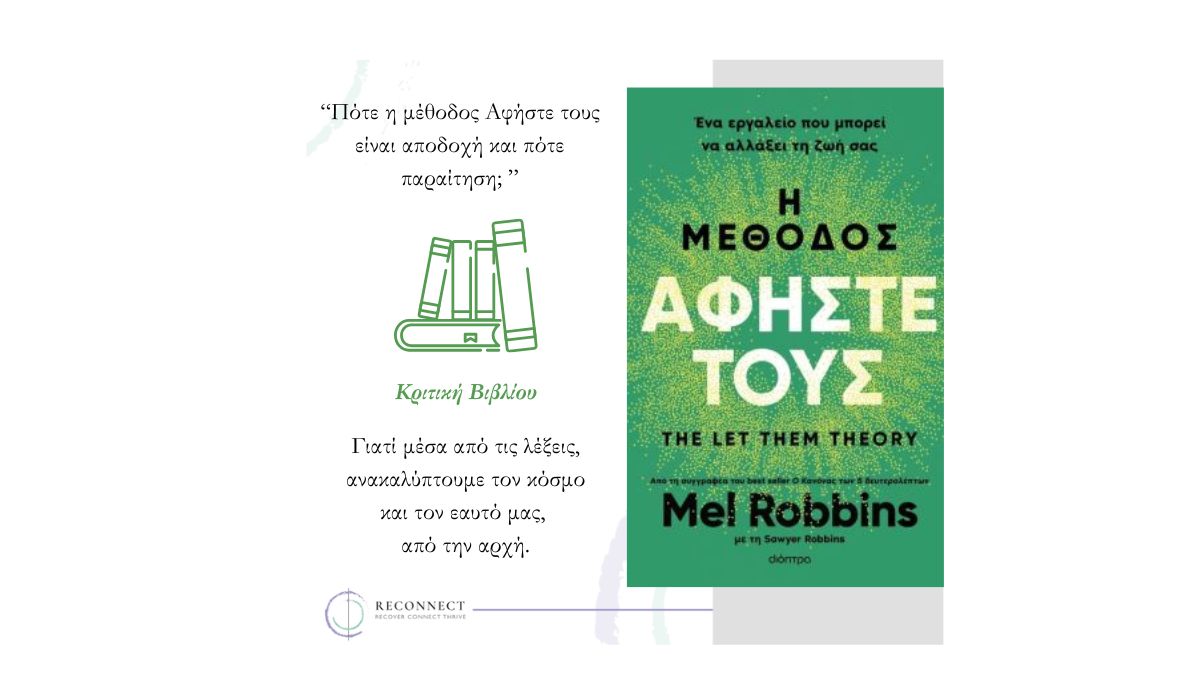
Mel Robbins's «The Let Them Theory» is not just another self-help book, it is a phenomenal book!
The question worth asking is whether what sold so widely truly deserves our trust. And the answer, as is often the case with everything that goes viral, is more complex than a simple yes or no.
The central idea is in the title
The core idea fits into two words: «Let Them». This means that when someone does or says something you don't like, you don't fight to change them. You recognise that their choice is theirs, not yours to control.
Of course, the Mel Robbins is clear: this is only half the equation. The second part, equally important, is «Let Me» (Let Me). Once you accept the other person's choice, you turn your focus to what you are doing. How you react. What you choose. Without «Let Them», «Let Them» would simply mean resignation.
Across twenty chapters, Mel Robbins combines personal experiences, such as her experience of unemployment, an $800,000 debt, and everyday family incidents with her children, with practical thinking frameworks:
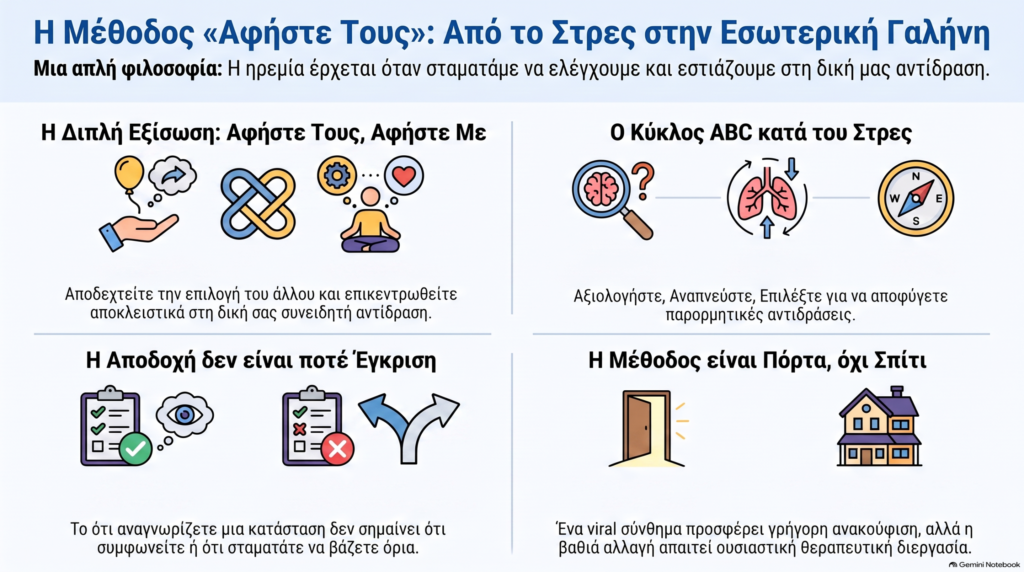
- The «Let Them» and «Let Me» dichotomy: the balance between allowing others to act as they wish and focusing exclusively on your own conscious reaction.
- The «ABC Cycle» (Assess / Breathe / Choose): a three-step tool for halting automatic stress and avoiding impulsive reactions.
- The metaphor of the seesaw: a visualisation for relational balance and when we take on more weight than is our share.
In our therapeutic team at ReConnect Therapy we frequently encounter people who exhaust themselves daily trying to act as the emotional regulators of their environment. For such a person, first contact with the book's philosophy truly acts as a deep breath of relief.
The Let Them Theory is nothing new
What few readers know is that «Let Them» is not a new discovery. Instead, it is a popular, highly condensed version of Stoicism and Eastern philosophy developed based on the distinction between what we control and what we cannot control with the aim of achieving equanimity.
We also find it in a technique that has been taught for decades in therapy: namely, radical acceptance (radical acceptance), a skill developed by psychologist Marsha Linehan within Dialectical Behaviour Therapy (DBT).
Radical acceptance is defined as the complete, open recognition of reality as it is, without anger and without fighting against it. It is not about how we feel about what is happening to us; it is about whether we stop fighting something that has already happened and cannot be changed.
However, there is a point that is emphasised time and again in the clinical version, and which is easy to lose in a simple slogan: acceptance does not mean approval. Acknowledging that something happened, or that this is how it is right now, does not mean you agree with it, that you allow it to continue, or that you stop taking care of yourself in relation to it. Linehan wrote an entire, structured ten-step protocol around this skill because she knew how easily people confuse «I accept it» with «it's okay»!
Where it works well
It is no coincidence that «The Let Them Theory» touched so many people.
- It takes a real, provenly useful technique and makes it accessible to people who would never open a clinical DBT manual.
- Highlights the difference between healthy acceptance and dangerous tolerance. Two full chapters deal specifically with when helping someone who is struggling becomes rescuing instead of supporting (recognising enabling).
- Offers quick relief to individuals suffering from chronic anxiety for social validation (people pleasers). Because people often
We seek acceptance and tremble at rejection
Where caution is needed
The problem lies not so much in the book itself, but in what ultimately reached the general public.
- A sixty-second video and a tattoo leave no room for twenty chapters of nuance. What went viral was the naked «Let Them», without the distinction that clinical radical acceptance deems necessary: acceptance does not mean approval.
Radical acceptance, in its original clinical context, applies to things that are truly out of control, such as a loss, a diagnosis, something that has already happened and cannot be changed. Human relationships, however, are rarely that static. They are often negotiable, through boundaries, through a difficult conversation, through saying «this does not work for me». If someone applies the «Let them» method to a partner who consistently ignores them, to a boss who exploits them, or to a child taking dangerous risks, the motto can easily become an excuse for not doing what is truly needed, namely speaking up, setting a boundary, intervening. Boundaries are blurred, as I also mention in the article Feeling like a victim? You are not alone! Living inside a triangle…
- The book presents statistics data, such as that seven out of ten people live in chronic stress because they try to control others, without a clear reference to a specific study. This does not necessarily mean it is wrong, but rather that the reader has no way of verifying them.
What we take away
«The Let Them Theory» is not a bad idea. It is a good starting point, but not a final destination. It works best when we remember that it is only half the equation, meaning that «Let me be» needs equal space, and that accepting something never means you stop looking after yourself within it.
Behind every simple life-changing slogan in a video, there is usually a much slower, a more complex job. The kind that happens in a therapy room. So the «Let them» method can be the door. Certainly, though, it is not the house.
If you often feel you are saying «Let them» more and «Let me» less, get in touch here to find the ideal balance together.
Read also:
Books – companions on the journey of psychotherapy, worth reading
Review in The Body Keeps the Score. Ultimately, does the body keep the score?;
I would love to read your message… I make sure to read all messages and reply to as many as I can.
The article is based on the science of psychology and the clinical experience of psychotherapists. It has an educational character and does not replace psychotherapy, medical or psychiatric evaluation, nor can it cover the uniqueness of every relationship and every experience. If you are experiencing intense psychological strain, dysregulation, violence, coercion, or the feeling that you are not a safe person within your relationship, it is important to seek personalised professional support.
Artificial intelligence may be used supportively in the process of researching, organising and cross-referencing contemporary literature. However, the final text, ideas, clinical judgement, language and responsibility for publication belong to us. Every article is written and edited with human thought, clinical experience and respect for the person reading it.
Written by Philippos Gkekas, Psychologist-Psychotherapist, creator of ReConnect Therapy along with the scientific team of ReConnect Therapy.
References
Robbins, M. (2024). The Let Them theory: A life-changing tool that millions of people can’t stop talking about. Hay House.
Beattie, M. (2008). Codependent no more: How to stop controlling others and start caring for yourself. Hazelden Publishing.
Chapman, A. L. (2006). Dialectical behavior therapy: Current status and future directions. Psychiatry (Edgmont), 3(9), 62–68.
Linehan, M. M. (2015). DBT skills training manual (2nd ed.). The Guilford Press.